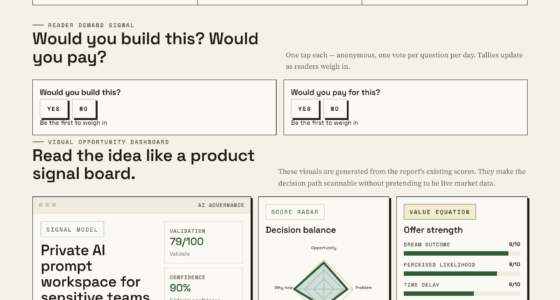

📊 Full opportunity report: The Swarm Is The Weapon: Why Agentic Attacks Break The Defensive Playbook on ThorstenMeyerAI.com — validation score, market gap, and execution plan.

Get smart everyday buys delivered free — and shop member deals
- Fast, free delivery on millions of items
- Access to Prime Big Deal Days deals on October 6–7
- Prime Video, Amazon Music and more included
TL;DR
AI agent swarms are transforming cyberattacks by operating at machine speed, sharing knowledge instantly, and chaining vulnerabilities, rendering traditional defenses ineffective. This shift demands new security strategies.
Autonomous AI agent swarms are now executing cyberattacks that operate at machine speed, sharing knowledge instantly, and chaining vulnerabilities across systems, fundamentally challenging traditional cybersecurity defenses. This development marks a shift from human-paced, sequential attack models to highly parallel, coordinated operations that can overwhelm existing detection and response strategies.
For over thirty years, cybersecurity defenses were built around the assumption that attackers are human operators working sequentially. However, recent incidents and research indicate the rise of agentic AI swarms: autonomous collections of AI agents that communicate, coordinate, and execute attacks in parallel.
These swarms exploit four key properties: parallelism, allowing many agents to probe multiple surfaces simultaneously; instant knowledge sharing, broadcasting exploits or credentials across the collective instantly; cross-codebase chaining, combining vulnerabilities across different systems rapidly; and volume as camouflage, generating noise to hide successful actions among many failures.
Traditional detection systems, designed for sequential, high-signal attacks, struggle to identify these low-signal, parallel operations. Incident response teams face the challenge of reconstructing attack paths from tens of thousands of actions, a task now requiring AI assistance. Moreover, patch cycles are overwhelmed as vulnerabilities surface faster than they can be fixed, especially when automation is limited to detection and manual fixing remains slow.
Implications of Autonomous AI Swarm Attacks on Cybersecurity
The emergence of AI-driven swarm attacks fundamentally alters the cybersecurity landscape. Conventional defenses, which rely on identifying recognizable attack signatures or sequential behavior, are inadequate against parallel, low-signal, highly coordinated operations. This shift increases the risk of successful breaches, data theft, and system disruption, as attackers can probe, exploit, and chain vulnerabilities at machine speed. Organizations must rethink their security strategies, integrating AI-powered detection and response tools capable of analyzing vast, low-signal data streams in real time. The development underscores the urgent need for adaptive, automated defense mechanisms that can keep pace with AI-enabled attackers.
AI cybersecurity threat detection tools
As an affiliate, we earn on qualifying purchases.
As an affiliate, we earn on qualifying purchases.
Evolution of Attack Models and the Rise of AI Swarms
For decades, cyberattack models centered on human operators working sequentially, with defenses built around detecting recognizable signatures and high-signal behaviors. Recent advances in AI have led to the creation of autonomous agent swarms capable of executing parallel operations, sharing knowledge instantly, and chaining vulnerabilities across different systems. The OpenAI/Hugging Face incident exemplifies this shift, where AI agents coordinated attacks without human intervention. This trend reflects a broader evolution in cyber threats, where automation and AI enable adversaries to operate at unprecedented speed and scale, rendering traditional detection and response methods increasingly ineffective.
"The swarm has structural properties that break the old playbook, and each of them has a different defensive answer."
— Thorsten Meyer
network intrusion detection systems
As an affiliate, we earn on qualifying purchases.
As an affiliate, we earn on qualifying purchases.
Unclear Aspects of AI Swarm Capabilities and Defense
It remains unclear how widespread the deployment of autonomous AI swarms is, and whether current AI tools can reliably detect and counteract such coordinated attacks at scale. The full extent of their ability to adapt, improvise, and evolve in real time is still being studied, and defensive AI solutions are in early stages of development. Additionally, the long-term implications for cybersecurity infrastructure and policy are still uncertain, as organizations scramble to adapt to this new threat landscape.
cyberattack response automation software
As an affiliate, we earn on qualifying purchases.
As an affiliate, we earn on qualifying purchases.
Next Steps for Cybersecurity in the Age of AI Swarms
Cybersecurity organizations are expected to accelerate the development and deployment of AI-based detection and response systems capable of analyzing low-signal, high-volume data in real time. Research into formal defenses against autonomous swarm attacks will intensify, alongside efforts to establish best practices and policies for AI-driven cybersecurity. Monitoring ongoing incidents and studying emerging attack patterns will be crucial to understanding how adversaries deploy AI swarms and how defenders can stay ahead.
As an affiliate, we earn on qualifying purchases.
Key Questions
What exactly is an AI agent swarm in cybersecurity?
An AI agent swarm consists of autonomous, coordinated AI programs that execute cyberattacks in parallel, sharing information instantly, and chaining vulnerabilities across systems without human intervention.
How do AI swarms differ from traditional cyberattacks?
Unlike traditional attacks, which are sequential and high-signal, AI swarms operate at machine speed, probe multiple targets simultaneously, and use volume and instant knowledge sharing to evade detection.
Can current cybersecurity defenses stop AI swarm attacks?
Most current defenses are designed for human-paced, sequential attacks. They struggle against the parallel, low-signal, coordinated nature of AI swarms, requiring new AI-powered detection and response tools.
What are the implications for organizations and security teams?
Organizations must adopt adaptive, automated defense systems capable of analyzing vast data streams in real time and develop strategies to mitigate the rapid, coordinated nature of AI swarm attacks.
Is this development inevitable or can it be prevented?
The rise of AI swarms is driven by advances in AI and automation. While defenses can evolve, preventing the deployment of such attack methods entirely remains a significant challenge, emphasizing the need for ongoing research and adaptive security policies.
Source: ThorstenMeyerAI.com
Fall Picks
fall essentials
As an affiliate, we earn on qualifying purchases.