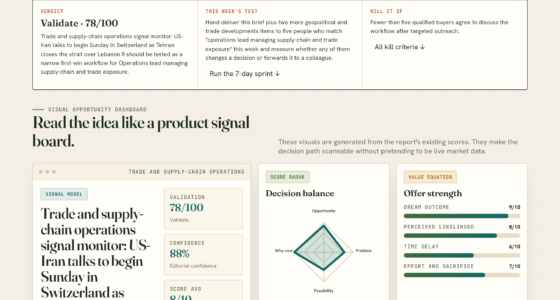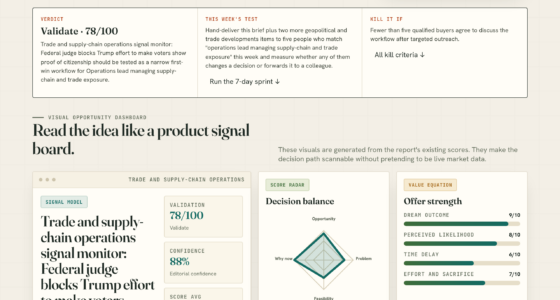

📊 Full opportunity report: IdeaClyst: The Validation Council on ThorstenMeyerAI.com — validation score, market gap, and execution plan.

Get smart everyday buys delivered free — and shop member deals
- Fast, free delivery on millions of items
- Access to Prime Big Deal Days deals on October 6–7
- Prime Video, Amazon Music and more included
TL;DR
IdeaClyst has launched a private idea validation council that uses two AI models to critically assess ideas through structured disagreement. This approach aims to improve decision quality and reduce costly errors in project planning.
IdeaClyst has launched a new AI-driven Validation Council designed to rigorously evaluate ideas before they reach decision-making stages, emphasizing structured disagreement over consensus. This innovation aims to improve decision quality by reducing the risk of adopting weak or plausible but flawed ideas, which can be costly in project development.
The Validation Council is a system developed privately by Thorsten Meyer and not publicly available. It uses two different AI models—Claude and Codex—to examine each idea from opposing angles. The process begins with a research pre-step, gathering relevant evidence and context, followed by five deliberation steps: framing, steelmanning, red-teaming, evidence-checking, and synthesizing a verdict. The models are designed to challenge each other, with disagreement seen as a feature, not a bug, to surface potential flaws. This structured approach aims to prevent the adoption of ideas that seem plausible but lack robustness, thereby saving time and resources in project planning. The system is provider-agnostic and runs locally on owned compute.IdeaClyst — the validation council
Most ideas don’t die from being bad — they die from being plausible and untested. A research pre-step, then two models cross-examining the idea before it earns a roadmap slot.
Independent commentary, produced with AI assistance under human editorial oversight. The views are the author’s own and may change. IdeaClyst is developed privately and is not publicly available. The council’s research, deliberation and verdicts are produced by automated models and may contain errors or shared blind spots — a verdict is auditable reasoning, not validated demand; verify independently before committing. Product and company names are trademarks of their respective owners; mention does not imply endorsement.
Why Structured Disagreement Improves Decision-Making
The introduction of the Validation Council offers a new method for organizations to vet ideas more thoroughly, potentially reducing costly failures caused by unchallenged assumptions. By leveraging opposing AI models, it minimizes the risk of confirmation bias and sycophantic agreement, leading to more robust decision-making. This approach is particularly relevant in fast-paced industries where rapid, yet reliable, idea validation can be a competitive advantage.
As an affiliate, we earn on qualifying purchases.
Background on Idea Validation and AI Use in Decision Processes
Traditional idea validation often relies on subjective judgment or single-model AI assessments, which can be prone to confirmation bias and overconfidence. The concept of using opposing models to evaluate ideas builds on the understanding that disagreement, when structured properly, can reveal weaknesses that consensus might overlook. Prior to this, IdeaClyst’s public IdeaNavigator provided open evidence-mined ideas, but the private Validation Council extends this concept into a rigorous, repeatable process for internal decision-making. The system’s development aligns with broader trends toward AI-assisted decision support and open-source innovation.
“Using two models to challenge each other transforms idea validation from a passive check into an active debate, making our decisions more trustworthy.”
— Thorsten Meyer, founder of IdeaClyst
As an affiliate, we earn on qualifying purchases.
Limitations of AI-Based Idea Validation Systems
While the Validation Council introduces a novel approach, it remains uncertain how well the system performs across different domains or complex real-world scenarios. Both models can share blind spots or produce confidently wrong conclusions, and the process cannot confirm market viability or actual success. Additionally, the system’s effectiveness depends on the quality of the initial research step and the framing of the debate, which can be influenced by user input and data availability. The potential for process-theater, where decisions appear more rigorous than they are, also remains a concern.
As an affiliate, we earn on qualifying purchases.
Future Developments and Adoption of IdeaClyst’s Validation Approach
The Validation Council is developed privately and its architecture is not publicly available. The company intends to gather feedback on its effectiveness and refine the process. Adoption by early users will reveal practical strengths and limitations, and additional integrations with project management tools are expected. Monitoring real-world outcomes will be essential to validate whether this structured disagreement truly improves decision quality and reduces costly errors.
As an affiliate, we earn on qualifying purchases.
Key Questions
How does the Validation Council differ from traditional idea review methods?
It uses two AI models to critically challenge each other, ensuring ideas are stress-tested through structured disagreement, rather than relying on single-model assessments or subjective judgment.
Can the system guarantee that an idea is market-ready or viable?
No, the Validation Council focuses on internal robustness and logical soundness; it cannot assess market feasibility or actual success potential.
Is the process open-source and customizable?
No, the system is developed privately and is not publicly available.
What are the main limitations of using AI models for idea validation?
Models can share blind spots, confidently produce wrong conclusions, and the process may give an illusion of rigor without guaranteeing real-world effectiveness.
Source: ThorstenMeyerAI.com
Fall Picks
fall essentials
As an affiliate, we earn on qualifying purchases.