📊 Full opportunity report: Matching Main Street Spaces With Businesses Looking For A Home on IdeaNavigator AI — validation score, market gap, and execution plan.

Get smart everyday buys delivered free with Prime
- Fast, free delivery on millions of items
- Prime Video, Amazon Music and more included
- Member-only deals all year
TL;DR
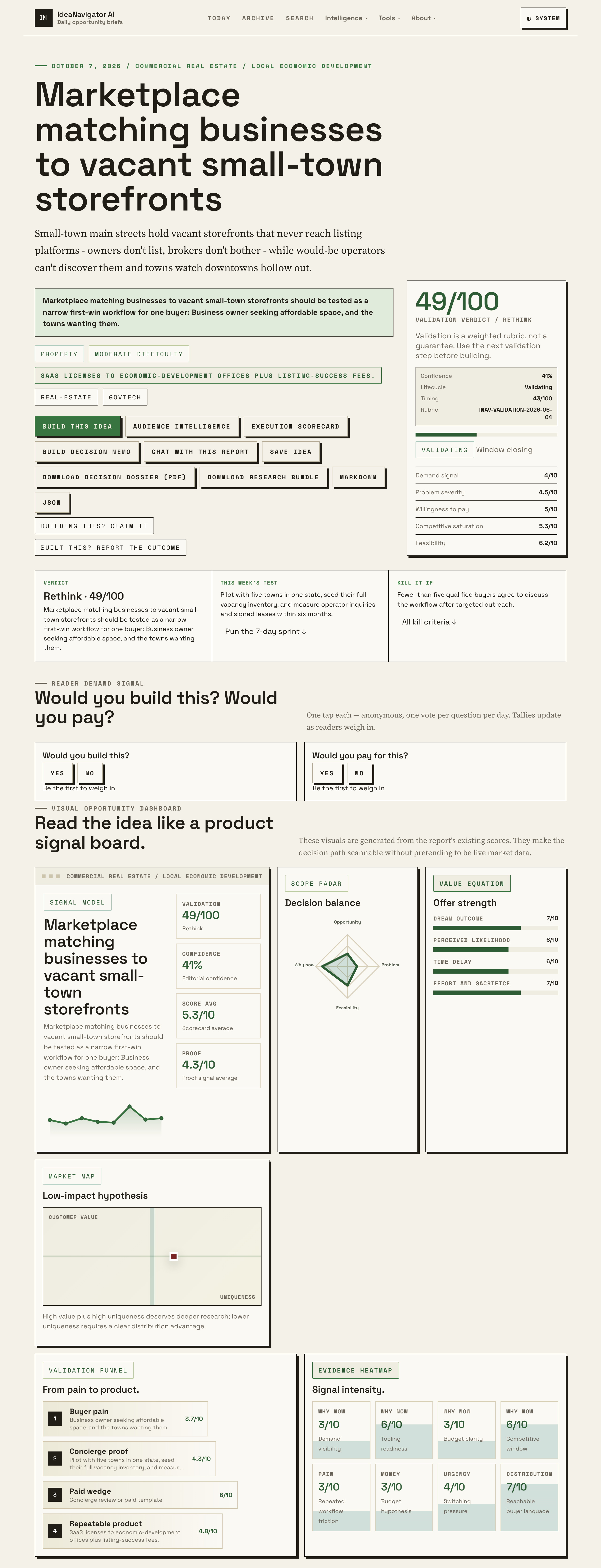
IdeaNavigator AI proposes testing a marketplace that lists vacant small-town storefronts and connects interested business operators with local economic-development offices. The proposed test would cover five towns in one state and track inquiries and signed leases over six months; no pilot results or launch announcement are provided.
IdeaNavigator AI has proposed a marketplace to match vacant small-town storefronts with business operators seeking space, with a suggested five-town pilot to test whether the service generates inquiries and signed leases. The concept would also route prospective matches through local economic-development offices, but no pilot launch, participating towns or operating results have been announced.
The proposed marketplace would let property owners and towns list storefronts with details including photos, floor area, rent and available incentive programs. Business operators could browse listings by town profile and foot-traffic data, then express interest in a space.
Under the plan, inquiries would go to the relevant local development office, with information about available grants attached to a potential match. The proposal does not specify which foot-traffic measures would be used, how grant eligibility would be checked or whether listings would be independently verified.
IdeaNavigator AI suggests that revenue could come from software licenses sold to economic-development offices and fees tied to successful listings. It recommends seeding a pilot with the full vacancy inventory of five towns in one state and measuring operator inquiries and signed leases over six months. These are proposed validation steps, not reported outcomes.
A Test for Main Street Leasing
The proposal targets a practical gap: a storefront can remain vacant even when a business is looking for space if the owner has not advertised it and local brokers are not handling the property. A shared listing system could make those spaces easier to discover and give towns one place to connect operators with local assistance.
For business owners, the potential benefit is access to spaces and incentive information that may otherwise be difficult to find. For towns, the proposed model could help development offices track interest and direct prospective tenants toward available programs. Whether that leads to signed leases, rather than just online inquiries, is the central question the suggested pilot is designed to answer.
The idea also has a possible funding path through public-sector software subscriptions and success-based listing fees. However, the proposal supplies no pricing, cost estimates or evidence of demand. Towns and property owners would need to see enough value in the service to provide accurate listings and keep them current.
vacant storefront listing platform
As an affiliate, we earn on qualifying purchases.
As an affiliate, we earn on qualifying purchases.
The Proposed Vacancy-Matching Model
The concept describes storefront vacancies that are not posted on established listing platforms because owners do not list them and brokers may not take them on. At the same time, would-be operators may be unable to discover suitable spaces, while town centers continue to have empty commercial properties. This is the problem the proposed marketplace is intended to address.
IdeaNavigator AI says two conditions make the idea timely: renewed interest in small towns associated with remote-work migration, and economic-development offices having grant money for matching efforts. The proposal does not provide data to quantify either trend or identify particular grants, locations or funding programs.
Its recommended next step is a narrowly scoped test rather than a broad rollout: choose five towns in one state, assemble their vacancy inventories and observe results for six months. The stated measures are operator inquiries and signed leases, which would distinguish initial interest from completed property deals.
small town commercial property signs
As an affiliate, we earn on qualifying purchases.
As an affiliate, we earn on qualifying purchases.
Pilot, Funding and Data Questions
No pilot has been confirmed, and the proposal names no participating towns, launch date, marketplace operator or development-office partners. It also does not state how many storefronts might be listed or whether owners have agreed to contribute their properties.
Several operating questions remain open. The proposal does not explain how the service would verify rents, availability, property condition or incentive eligibility; who would maintain listings; or how foot-traffic data would be sourced. It also provides no fee schedule, license pricing, expected operating costs or evidence that towns and businesses would use the platform.
The suggested six-month measures are not accompanied by target numbers or a method for comparing results with leasing activity that would have occurred without the marketplace. It is therefore unclear what level of inquiries or completed leases would count as a successful test.
business lease signage for storefronts
As an affiliate, we earn on qualifying purchases.
As an affiliate, we earn on qualifying purchases.
A Five-Town Test Is Proposed
The next step set out in the proposal is to recruit five towns in one state, gather a complete inventory of their vacant storefronts and publish listings with property and incentive details. A test would then track operator inquiries and signed leases over six months.
Before that test can begin, organizers would need to identify the participating towns, establish how listings and grant information will be checked, and decide how inquiries will be routed and measured. No schedule or recruitment process has been announced. Until those details are available, the marketplace remains a proposed workflow rather than an operating service.
Source: IdeaNavigator AI
local economic development marketing tools
As an affiliate, we earn on qualifying purchases.
As an affiliate, we earn on qualifying purchases.
Key Questions
What is the proposed marketplace?
It is a proposed online service for listing vacant small-town storefronts and connecting interested business operators with property owners and local economic-development offices.
Has the marketplace launched?
No launch is confirmed. The proposal outlines a possible service and a pilot approach, but identifies no operator, launch date or participating towns.
What information would storefront listings include?
The proposed listings would include photos, size, rent and incentive programs. Operators could also browse by town profile and foot-traffic data, though the data sources are not specified.
How would the proposal be tested?
IdeaNavigator AI recommends a pilot in five towns in one state, with the full vacancy inventory listed and operator inquiries and signed leases tracked over six months. No results are available because no pilot is confirmed.
How could the service make money?
The suggested revenue streams are software licenses for economic-development offices and fees tied to successful listings. No prices, financial projections or customer commitments are provided.
Source: IdeaNavigator AI
Halloween Picks
halloween
As an affiliate, we earn on qualifying purchases.