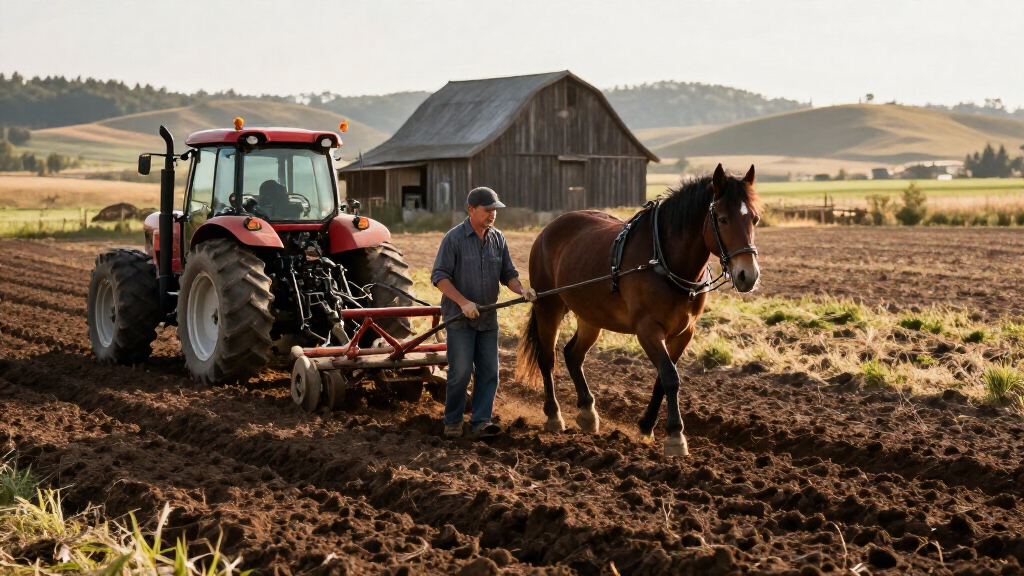

🔍 Read the full analysis: Tractors Vs. Horses: A Look At 26.7 Million Working Animals on ThorstenMeyerAI.com

Get smart everyday buys delivered free with Prime
- Fast, free delivery on millions of items
- Prime Video, Amazon Music and more included
- Member-only deals all year
TL;DR
A November 4, 2026, article from ThorstenMeyerAI.com revisits the mechanization of U.S. farming, when horses and mules on farms peaked at 26.7 million in 1918 and fell to 3.1 million by 1960. It links that shift to tractors, changing farm employment and a modern debate over whether the horse’s displacement offers a useful analogy for automation’s effects on people.
U.S. farm horses and mules peaked at 26.7 million on January 1, 1918, before tractors and other machinery sharply reduced their role, according to a historical account published November 4 by ThorstenMeyerAI.com. By 1960, the farm-animal count was 3.1 million, a shift that changed land use and farm work and now serves as a point of comparison in debates over automation and jobs.
The account draws on figures reprinted in the U.S. Census Bureau’s Historical Statistics of the United States, Colonial Times to 1970, which reported estimates from the Department of Agriculture. Horses alone peaked at 21.4 million in 1915; mules continued to increase, bringing the combined total to 26.7 million in 1918. The figures count animals on farms, not every horse and mule in the country.
Feeding those animals required substantial land. In 1915, an estimated 93 million acres of harvested cropland—out of 340 million acres—grew feed for horses and mules, according to the cited historical series. The account says the estimate was still 90 million acres in 1920 and had fallen to about five million acres by 1960.
Tractor numbers rose rapidly over the same period: roughly 1,000 in 1910, 246,000 in 1920 and 4.69 million in 1960. Horses and mules remained more numerous for decades; the two counts crossed around 1955, when the cited figures show 4.35 million tractors and 4.31 million horses and mules. The underlying counts have differing dates and methods, a qualification noted in the account.
The Land and Labor Shift
The change was not simply a swap of animals for machines. Land once used to grow feed could be used for crops for people or markets, while machinery helped fewer farm workers produce more. The account cites a Department of Agriculture estimate that one farm worker supplied 7.1 people in 1910, rising to 47.1 in 1970. That measure includes people abroad supplied through exports.
Farm employment also fell: the account gives a peak of 13.6 million in 1916 and 4.5 million in 1970, while the overall U.S. labor force doubled. It describes new employment as increasingly urban, meaning the economic shift involved migration and changes in where people worked, not just new equipment. Those historical trends make the episode relevant to current questions about automation, though they do not by themselves establish what will happen to workers in other industries.
The account also notes that farm machinery extended beyond tractors. Combine harvesters, which cut, thresh and clean grain in one pass, increased from about 4,000 on U.S. farms in 1920 to 1.042 million in 1960. Corn pickers, balers and milking machines, alongside fertilizer and improved seed, contributed to changing output and labor needs.
Products Worth Considering

FLEXISPOT 60 x 30-Inch Bamboo Electric Standing Desk with White Frame

LG PuriCare AeroHit Smart Air Purifier for Large Rooms up to 1000 sq ft, True HEPA Filter with 360° Airflow, PM1.0 Sensor & LED Air Quality

Apple MacBook Neo 13-inch Laptop with A18 Pro Chip, 8GB Memory, 512GB SSD, Liquid Retina Display, and Touch ID (Blush)
As an affiliate, we earn on qualifying purchases.
How Tractors Replaced Animal Power
Early gasoline tractors existed before World War I but were described in the account as heavy, expensive and better suited to large farms. Ford introduced the Fordson in 1917. The Henry Ford museum describes it as a mass-produced, inexpensive lightweight tractor designed for smaller farmers; the account says the 100,000th Fordson left the assembly line on February 21, 1920.
The historical narrative offers a practical reason for adoption: animals needed feed year-round, while a tractor required fuel when it was used. As tractor ownership spread and other machinery followed, farmers gradually stopped breeding replacement work animals. The account says the horse population aged out rather than ending in one sudden event. That description is a summary of the historical pattern, not a claim that every animal or farm followed the same path.
The piece connects this history to economist Wassily Leontief, who compared workers to horses displaced by tractors in 1983. It stresses a limit of the analogy attributed to Leontief: horses could not vote. Human workers can influence policy and institutions, and the history of farm mechanization cannot predict how future automation will affect wages, employment or working conditions.
“The Fordson was “the first mass-produced and inexpensive lightweight tractor.””
— ThorstenMeyerAI.com account, citing the Henry Ford museum
Limits of the Horse Comparison
The historical figures document a major change in U.S. agriculture, but they do not settle what automation will do to workers today. The account presents the horse comparison as an analogy and does not quantify how many human jobs current systems will eliminate, create or alter. It also does not establish that employment transitions in other countries or industries will follow the U.S. farm pattern.
Modern automation examples remain specific in scope. The account says John Deere’s 16-camera autonomy kit, described as introduced in February 2025, performs tillage on select large tractors; it does not say that all farm operations are driverless. It also reports that China said about 74% of ploughing, sowing and harvesting was mechanized in 2023, without providing further detail here on the measure’s definition or comparability with U.S. historical data. The extent of deployment, effects on workers and longer-term results remain unclear from the material provided.
Where Farm Automation Goes
The account points to continued development of driverless farm equipment, but provides no announced schedule for wider rollout of the cited systems. The next useful evidence will be operational: which tasks equipment can perform reliably, how many farms adopt it, and whether use changes labor requirements or farm costs. Those outcomes are not established by the historical comparison alone.
For the longer automation debate, future data on employment, productivity, wages and worker movement will be needed to test how far the horse analogy applies. The historical record shows that farm machinery and related changes reduced the need for animal power and farm labor over several decades; how present-day technologies affect people remains an open question.
Key Questions
When did U.S. farm horses and mules reach their peak?
The cited historical series puts their combined peak at 26.7 million on January 1, 1918. Horses alone peaked earlier, at 21.4 million in 1915.
How many farm horses and mules remained by 1960?
The account gives a 1960 count of 3.1 million, down from the 1918 peak. The figures refer to animals on farms.
When did tractors outnumber horses and mules?
The counts crossed around 1955. The account cites 4.35 million tractors and 4.31 million horses and mules at that point, while noting that the underlying counts used differing dates and methods.
Does the horse story prove automation will eliminate human jobs?
No. The account presents the history as an analogy, not a rule or forecast. It notes a key difference: human workers, unlike horses, can participate in political and social decisions.
Are today’s farm tractors fully driverless?
The account describes a John Deere autonomy kit for tillage on select large tractors, not universal driverless farming. It does not provide a broader adoption rate or evidence about the kit’s effects on farm employment.
Source: ThorstenMeyerAI.com