

TL;DR

Get smart everyday buys delivered free with Prime
- Fast, free delivery on millions of items
- Prime Video, Amazon Music and more included
- Member-only deals all year
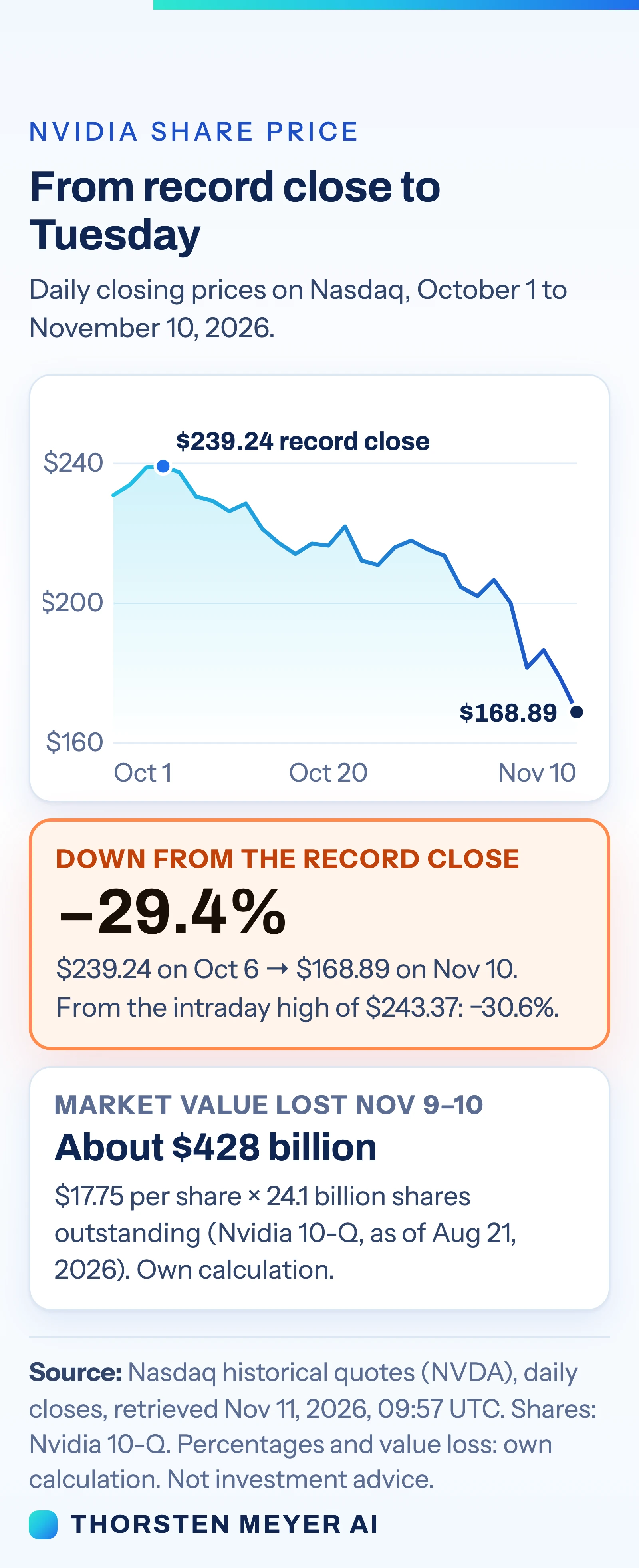
Nvidia shares closed at $168.89 on Nov. 10, 29.4% below their Oct. 6 record close. The decline coincided with pressure across technology stocks and reports of a board investigation, a proposed shareholder lawsuit and scrutiny of a customer over export controls. Nvidia is due to report third-quarter results on Nov. 17.
Nvidia shares closed at $168.89 on Tuesday, Nov. 10, down 29.4% from their Oct. 6 record closing price, as a broad technology selloff coincided with reports of scrutiny involving the company. The decline matters beyond Nvidia: its large weight in major stock indexes means sharp moves in the shares can affect index performance and investor portfolios.
From the Nov. 6 close of $186.64 to Tuesday’s close, Nvidia lost $17.75 per share. Applying the 24.1 billion shares outstanding reported in the company’s latest quarterly filing produces an estimated reduction of about $428 billion in market value over those two trading days. That estimate is a calculation based on the cited closing prices and share count; it is not a measure of cash leaving the company.
Nvidia’s Tuesday close was 29.4% below its Oct. 6 record close of $239.24. Compared with the intraday high of $243.37 reached that day, the shares were down 30.6%. Using the same reported share count, the fall from the record close equates to an estimated $1.7 trillion in market value. The Motley Fool described the decline as a loss of 30% from the all-time high.
The sharper leg of the decline came in early November. After closing at $200.13 on Nov. 4, Nvidia fell 9.26% on Nov. 5 to $181.60, rebounded 2.78% on Nov. 6 and then dropped 4.27% on Nov. 9 and 5.47% on Nov. 10. From the Nov. 4 close through Nov. 10, the stock fell 15.6% over four trading sessions. These daily percentage changes are calculated from Nasdaq closing prices.
Nvidia’s Weight Reaches Index Investors
Nvidia’s decline can influence broad market measures because the company makes up a substantial share of major funds tracking U.S. stocks. As of Nov. 9, Nvidia represented 6.64% of SPY, an S&P 500 tracker, and 7.10% of QQQ, a Nasdaq-100 tracker. Those weights mean a steep move in Nvidia may weigh on the funds even when other holdings move differently.
CNBC reported that Nvidia “dragged down the three major averages” on Tuesday. Reuters reported that Microsoft briefly overtook Nvidia as the world’s second-most valuable company during that session; by the close, AFP reported Nvidia had returned to second place behind Apple. The ranking illustrates how market values can shift with share prices, but it does not establish the cause of Nvidia’s decline.
The stock’s performance also draws attention because Nvidia supplies chips used in many AI systems and data centers. Businesses planning AI infrastructure and investors exposed through indexes may watch both demand for those systems and the cost of financing them. The reported market moves do not, by themselves, establish that demand for Nvidia products has changed.
Products Worth Considering

FLEXISPOT EN1 Electric Standing Desk, 48 x 24 in, Black

FLEXISPOT Adjustable Workbench with Hand Crank, 47.2 x 23.6 Rubberwood Top

FLEXISPOT Electric Adjustable Workbench, 55 x 28 Inches, White
As an affiliate, we earn on qualifying purchases.
A Selloff With Two Sources
The available reporting points to market-wide pressures as well as developments specific to Nvidia. AFP attributed broad technology selling after the U.S. midterm elections to fears that the pace of AI data-center construction could slow. The Motley Fool said markets expected the incoming Congress to be more hostile to unrestricted AI development and noted that several incoming governors had announced plans for construction moratoriums. These are reported expectations and proposals, not confirmation that data-center projects have been halted.
Another pressure came from inflation and interest-rate expectations. CNBC reported that the consumer price index rose 0.4% in October, above economists’ 0.3% expectation. AFP said the inflation reading, which showed prices slowing less than expected, boosted expectations of Federal Reserve rate hikes. CNBC reported the Nasdaq fell 0.7% on Tuesday. Higher borrowing costs can affect companies financing data-center projects, though the reporting does not quantify how much rate expectations contributed to Nvidia’s share-price move.
Company-specific headlines arrived during the same period. A board investigation was announced Nov. 8, a proposed shareholder class action was filed Nov. 9, and a Nvidia customer faced scrutiny over export controls, according to the source material’s cited reporting. Reuters also cited uncertainty about the outlook for AI. The available information does not assign a precise share of the stock’s fall to any one headline.
““has lost 30% of its value” from its all-time high”
— The Motley Fool
What the Price Drop Cannot Show
The cited reporting does not establish how much each factor contributed to Nvidia’s losses. Broader concerns about data-center construction, inflation and rates were reported alongside company-specific legal, governance and export-control headlines. Their timing does not prove that any single development caused a particular portion of the price decline.
The market-value estimates use the share count disclosed as of Aug. 21, 2026, held constant for the calculation. They are approximations rather than a live measure of the company’s value. The source material also does not detail the scope or findings of the board investigation, the allegations in the proposed lawsuit, or the outcome of scrutiny involving the customer. Those matters should not be treated as established findings.
It also remains unclear whether the reported policy concerns will lead to changes in data-center construction or AI investment, and whether the inflation reading will alter Federal Reserve decisions. The price figures are through the Nov. 10 close; later trading may change the picture.
Results Due November 17
Nvidia is scheduled to report its third-quarter results on Nov. 17. Investors and businesses will be able to compare the company’s reported performance with the market’s concerns about AI demand and data-center spending. The source material does not provide results in advance, so the report’s figures and any updated outlook remain unknown.
Further information about the board investigation, proposed shareholder case and export-control scrutiny may clarify the company-specific issues, but no outcome is established in the cited material. In the meantime, the share-price and market-value figures in this report reflect historical trading through Nov. 10; they do not predict future performance or provide a buy or sell recommendation.
Key Questions
Nvidia closed at $168.89 on Nov. 10, 29.4% below its record close of $239.24 on Oct. 6. Measured from the Oct. 6 intraday high, the decline was 30.6%.
How was the estimated $428 billion market-value loss calculated?
The estimate multiplies the $17.75 per-share decline from the Nov. 6 close to the Nov. 10 close by the 24.1 billion shares outstanding reported in Nvidia’s latest quarterly filing. It is an approximation using a fixed share count.
What factors were reported alongside the decline?
Reports cited concerns about the pace of AI data-center construction, an inflation reading above economists’ expectations, and company-specific developments including a board investigation, a proposed shareholder class action and scrutiny of a customer over export controls. The reporting does not quantify each factor’s effect on the stock.
When is Nvidia’s next earnings report?
Nvidia is scheduled to report its third-quarter results on Nov. 17, 2026. The figures and any updated company outlook were not available in the cited material.
Source: Thorsten Meyer AI