

TL;DR
OpenAI launched ChatGPT Wallet on November 13, 2026, allowing eligible US ChatGPT Pro subscribers to authorize purchases made by its dots agents. Each purchase requires review and a security check, while a card-network token keeps the real card number from the agent and merchant. Spending limits and autonomous purchases are planned but unavailable, and the rollout is limited to dots.
OpenAI launched ChatGPT Wallet on November 13, letting its cloud-based dots agents pay for items on a user’s behalf after the user reviews the purchase and approves it with a security check. The initial rollout is limited to ChatGPT Pro subscribers aged 18 or older in the United States with eligible US-issued cards, and the feature currently works through dots only.

Get smart everyday buys delivered free with Prime
- Fast, free delivery on millions of items
- Prime Video, Amazon Music and more included
- Member-only deals all year
The purchase flow keeps a user in control at checkout. A dot can find an item and fill a cart on a retailer’s website; before payment, Wallet displays the items, total and selected card. The user must then approve that specific purchase, using a security check such as Face ID or a fingerprint. OpenAI says there are no spending limits or pre-approved purchases at launch, so an agent cannot yet buy independently under rules set in advance.
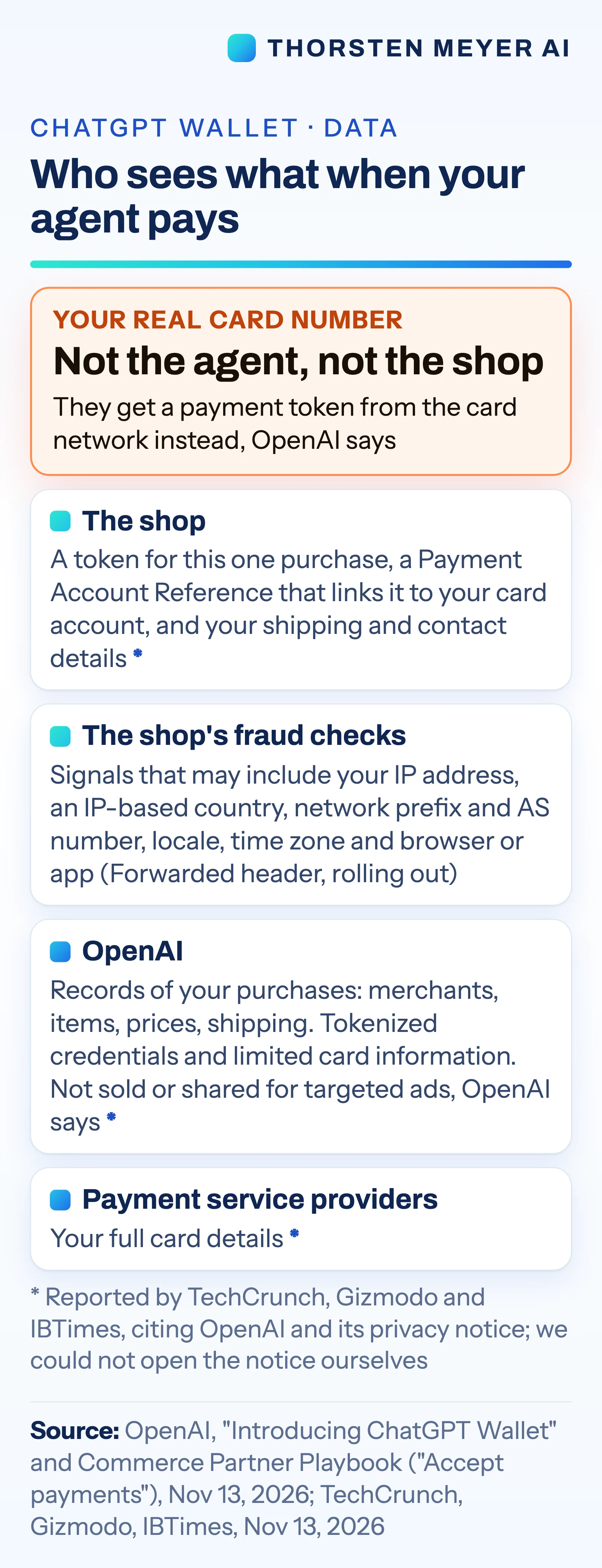
OpenAI says the merchant receives a payment token issued through the card network, with its own card number, security code and expiry date, instead of the user’s actual card details. The agent also does not see the real card number. The merchant still receives order information and may receive fraud-prevention signals, including an IP-based country and time zone, according to the source material.
OpenAI says Wallet was built with American Express, Mastercard and Visa. The company presents the feature as retaining card rewards and existing protections for eligible disputes. Returns and customer service remain the retailer’s responsibility; OpenAI tells merchants that “Customers are ultimately responsible for the actions they take.” The source material also reports that some sites and fraud systems may block or decline agent-made purchases.
A New Step at Checkout
Wallet gives OpenAI’s agents a way to move from shopping assistance to completing a transaction. Dots can work in the cloud using their own computer and browser, according to OpenAI documentation cited in the source material. Until this launch, they could research products and fill carts, but payment was the step they could not complete. The change matters because it connects an AI agent’s recommendations and browsing directly to a user’s card, while requiring the user to authorize each purchase.
The security design could make delegated shopping more practical by limiting exposure of the real card number. But tokenization does not settle every question about trust: the merchant still handles fulfillment and returns, fraud systems can reject agent activity, and the user remains responsible for actions they approve. For now, the required review and security check provide a clear point of user control, while the lack of spending rules limits how much can be delegated.
OpenAI says 1.2 billion people use ChatGPT each week and that many research products through the service. That figure and characterization are OpenAI’s, not independent evidence of Wallet demand. The limited Pro-only rollout means it is too early to tell how often people will use the feature or how merchants will respond.
Products Worth Considering

Canon SELPHY CP1500 Wireless Dye-Sublimation Photo Printer Bundle with 108 Sheets of Paper and 3 Ink Cartridges

FlexiSpot E6 Electric Standing Desk, 55 × 28 in, Bamboo Top, White Frame

Dell XPS Tower 8960 Desktop, Intel Core i7-13700, NVIDIA GeForce RTX 4060, 16GB DDR5, 512GB SSD
As an affiliate, we earn on qualifying purchases.
From Product Research to Payment
OpenAI describes dots as always-on agents that live in the cloud and have their own computer and browser. That setup allows them to continue working while a user’s own computer is off. Wallet supplies the payment step: the dot shops on a business’s website, but the user reviews and authorizes the charge before the token is used.
This is not OpenAI’s first attempt to support purchases. The source material says the company introduced Instant Checkout in September 2025, which let users buy selected products within a chat. IBTimes reported that OpenAI later dropped it because it was not flexible enough; The Decoder also reported that Wallet followed that effort. Those accounts provide context, but the launch materials cited here do not set out a detailed comparison between the two systems.
OpenAI’s announcement describes a broader ambition for agents in ChatGPT Work, Codex and dots to complete purchases. The launch described in the source material is narrower: Wallet initially rolls out through dots, not ordinary ChatGPT chats or ChatGPT Work. IBTimes reported that supported cards include certain American Express, Chase, Mastercard and Visa cards. OpenAI’s stated eligibility is limited to eligible US-issued cards, and the available material does not provide a full card-by-card list.
““An agent making a purchase should strengthen, not bypass, the trust built into payments.””
— Sherri Haymond, Mastercard’s head of digital commercialization
Limits and Coverage Still Open
OpenAI has said spending limits and pre-approved purchases may come “over time,” but it has not provided a release date or explained what controls will be offered. It is also unclear when Wallet will reach users outside the initial US Pro and dots rollout, or when it might be available in ordinary chats, ChatGPT Work or Codex.
The source material does not establish how widely merchants accept agent-made checkouts, which websites or fraud systems reject them, or how often a transaction may fail. OpenAI says the merchant gets some fraud-prevention signals, but the available information does not detail the full set of data shared in each transaction. Nor does it specify how OpenAI handles a complaint about an agent’s actions beyond the user’s approval record and the merchant’s role in service and returns.
OpenAI says eligible disputes retain existing card protections, but the source material does not specify the exact eligibility conditions or explain how those protections apply to every Wallet purchase. Its claim that the product is the “first” of its kind is OpenAI’s description; the provided material does not independently establish that comparison.
Rollout and Spending Controls
OpenAI says it is beginning with limited availability for ChatGPT Pro subscribers so it can learn from real-world use and work with partners. The company has not announced a timetable for a wider rollout. Users who qualify can expect the Wallet flow to require individual review and approval for each purchase under the launch version.
The next significant changes to watch for are the arrival of spending limits or purchase rules, broader access beyond dots, and evidence of how merchants handle agent-filled carts. Until OpenAI provides those details, Wallet remains a limited payment feature in which the user authorizes every charge and the retailer continues to handle fulfillment, returns and service.
Key Questions
Who can use ChatGPT Wallet at launch?
OpenAI says it is initially available to ChatGPT Pro subscribers aged 18 or older in the United States with eligible US-issued cards. The launch described in the source material works through dots.
Can a dot buy something without approval?
No. Under the launch flow, the user reviews the items, total and card, then approves each purchase with a security check. Spending limits and pre-approved purchases are not available yet.
Does the merchant see the user’s real card number?
OpenAI says the merchant receives a card-network payment token with its own payment details, rather than the real card number. The merchant does receive order information and may receive fraud-prevention signals such as an IP-based country and time zone.
Who handles returns or a payment dispute?
The retailer handles returns and customer service. OpenAI says eligible disputes can use the card’s existing protections, but the source material does not give the full eligibility rules.
When will spending limits or wider access arrive?
OpenAI has said spending controls may arrive “over time,” but has not announced a date. It has not provided a schedule for access beyond the initial US Pro subscriber rollout through dots.
Source: Thorsten Meyer AI