
📊 Full opportunity report: The Real Cost of a Local-Inference Rig in 2026 on ThorstenMeyerAI.com — validation score, market gap, and execution plan.

Get smart everyday buys delivered free with Prime
- Fast, free delivery on millions of items
- Prime Video, Amazon Music and more included
- Member-only deals all year
TL;DR
In 2026, owning a local inference rig for large language models involves significant hardware costs, primarily driven by VRAM capacity and GPU choices. Smart buyers focus on VRAM-per-dollar rather than raw speed, with used older GPUs offering better value. The decision depends on model size and intended use.
In 2026, the cost of building a local inference rig capable of running large language models has become more predictable, with VRAM capacity and hardware choices driving expenses. This matters because it affects whether organizations and individuals can afford to own their AI infrastructure, reducing reliance on cloud services.
The core factor in local inference hardware costs is the VRAM capacity. Models fit into GPU memory, and crossing the ‘VRAM cliff’—where models spill into slower system RAM—causes a dramatic drop in performance. For example, a 70B parameter model requires around 43GB of VRAM at FP16 precision, making only high-end GPUs or multi-GPU setups feasible for such models.
Most consumers and small organizations are advised to target models within the 26–32B range, which fit comfortably into a single 24GB GPU like the used RTX 3090 or 4090. These GPUs cost between $600 and $850 used, offering a high VRAM-per-dollar ratio compared to newer, more expensive cards like the RTX 5090. For larger models, multi-GPU setups or Macs with large unified memory are necessary, significantly increasing costs.
Interestingly, the analysis shows that older GPUs such as the used RTX 3090 provide better value for inference tasks than the latest flagship cards, due to their VRAM capacity and lower price. For example, four used 3090s can pool nearly 96GB VRAM for under $3,200, enough to run a 70B model at high quality.
The real cost of a local-inference rig
Owning beats renting for steady AI work — so what does a local rig cost in 2026? The unintuitive, good news: the most expensive build is almost never the smartest one. It all comes down to one rule.
The difference is only whether the weights fit. LLM inference is memory-bandwidth-bound — VRAM capacity is the hard limit you build around. Compute specs are mostly noise.
The squeeze reframes the rig like everything else in this series: discipline beats maximalism. VRAM is exactly the memory under most pressure, so over-buying it is the 128GB-“to-be-safe” trap, only worse per gigabyte. Take the cheap, high-value step to 24GB (the gateway to the 30B class), reach for used 3090s and MoE models, and use quantization to climb a tier without buying silicon. Sized right, the rig pays for itself against the cloud’s ever-rising hidden bill. Next: Apple Silicon’s quiet memory advantage.
Implications of Hardware Choices for Local AI Deployment
Understanding hardware costs and VRAM limitations in 2026 is crucial for anyone considering owning their AI inference setup. The emphasis on VRAM-per-dollar guides cost-effective investments, enabling more organizations to run large models locally and reduce cloud dependency. This shift could reshape AI deployment strategies and hardware markets.
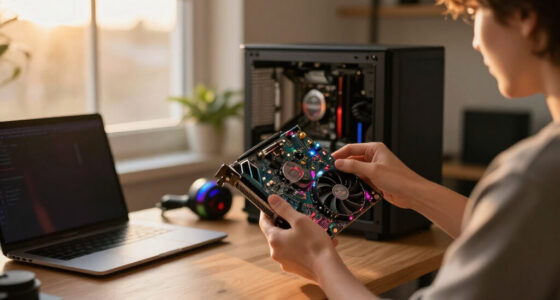
used NVIDIA RTX 3090 GPU for AI inference
As an affiliate, we earn on qualifying purchases.
As an affiliate, we earn on qualifying purchases.
Hardware Market Trends and Model Size Requirements in 2026
The 2026 landscape is shaped by the memory bottleneck in GPU inference, where VRAM capacity determines feasible model sizes. The rise of models like Qwen3 32B and MoE architectures offers efficiency gains, but hardware constraints remain. Previously, high compute power was the focus, but now VRAM capacity and cost efficiency dominate decisions. The market for used GPUs like the RTX 3090 has grown, driven by their superior VRAM-per-dollar ratio for inference tasks.
“Used older GPUs like the RTX 3090 are surprisingly cost-effective for inference, offering better VRAM-per-dollar than the latest flagship cards.”
— Industry expert in GPU resale markets
high VRAM graphics cards for AI models
As an affiliate, we earn on qualifying purchases.
As an affiliate, we earn on qualifying purchases.
Unresolved Questions About Hardware Scalability and Future Models
It is not yet clear how upcoming hardware innovations or new model architectures will alter the VRAM requirements or cost landscape. The impact of emerging memory technologies or AI-specific accelerators remains uncertain, as does the long-term viability of multi-GPU setups for smaller organizations.
As an affiliate, we earn on qualifying purchases.
Next Steps for Building Cost-Effective Local Inference Setups
In the coming months, hardware prices for GPUs—particularly used markets—will continue to fluctuate. Buyers should monitor developments in GPU memory technology and consider incremental upgrades, focusing on VRAM capacity. Additionally, software optimizations and new model compression techniques may further influence hardware requirements and costs.
As an affiliate, we earn on qualifying purchases.
Key Questions
What is the most cost-effective GPU for local inference in 2026?
Used RTX 3090s currently offer the best VRAM-per-dollar ratio, making them the most cost-effective choice for many inference tasks.
How does VRAM capacity impact model performance?
If the model fits entirely in GPU VRAM, inference runs at full speed. Crossing the VRAM cliff causes a drastic slowdown, making larger models impractical without multiple GPUs or large memory systems.
Can I run large models on Macs or other consumer hardware?
Yes, Macs with large unified memory (like M-series chips) can handle large models, but their performance and compatibility vary. Hardware like the M5 Max with 64GB RAM offers a feasible, though different, alternative.
Will hardware prices continue to fall for inference use?
Prices for used GPUs like the RTX 3090 are likely to remain favorable, but market fluctuations and new hardware releases could influence availability and cost.
What are the main factors to consider when building a local inference rig?
Focus on VRAM capacity, cost per gigabyte, and the specific model size you plan to run. Avoid overspending on raw compute power if VRAM is the bottleneck.
Source: ThorstenMeyerAI.com
Halloween Picks
halloween
As an affiliate, we earn on qualifying purchases.