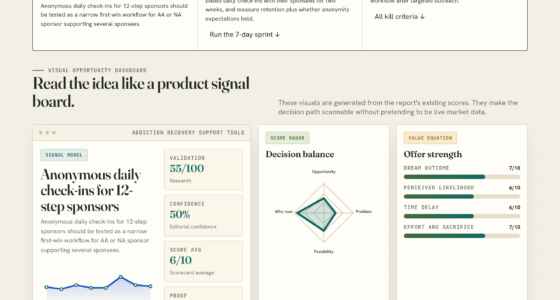

📊 Full opportunity report: When One Agent Isn’t Enough: Claude Now Builds Its Own Team of Agents on the Fly on ThorstenMeyerAI.com — validation score, market gap, and execution plan.

Get smart everyday buys delivered free with Prime
- Fast, free delivery on millions of items
- Prime Video, Amazon Music and more included
- Member-only deals all year
TL;DR
Anthropic’s Claude has introduced a new feature called dynamic workflows, enabling it to generate and manage its own team of specialized agents for complex tasks. This marks a significant step in AI orchestration, allowing for more reliable handling of multi-step projects.
Anthropic has announced that its AI model, Claude, can now dynamically build and orchestrate a team of specialized agents for complex tasks, a feature called dynamic workflows. This development allows Claude to generate tailored subagent structures on the fly, improving its ability to handle high-value, multi-step projects that previously challenged single-agent systems.
The new capability is part of a broader effort to address common failures of single-agent AI systems, such as laziness, bias, and goal drift. Instead of executing tasks within a single context window, Claude now writes small JavaScript programs that spawn, coordinate, and manage multiple subagents, each with focused objectives and isolated workspaces. These subagents can use different models suited to their specific roles, such as faster models for routine tasks and more powerful ones for judgment or verification.
Anthropic emphasizes that this feature is designed for complex, high-value tasks and uses more tokens than standard interactions. The system can decide which orchestration pattern to employ, such as classifying and routing tasks, splitting work into parallel units, or running competitive evaluations among multiple approaches. This enables Claude to perform more reliable, nuanced work, akin to a human team lead delegating and supervising specialized team members.
Mechanically, the workflow is a small JavaScript program that Claude writes and executes, capable of resuming interrupted tasks and adjusting its orchestration based on the task’s needs. The feature is triggered via a specific command or keyword, like “ultracode,” to initiate the creation of a custom team tailored for the task at hand.
When one agent isn’t enough: Claude now builds its own team on the fly
Skills package what you know; loops decide how far you delegate over time. Dynamic workflows are the third axis — within a single task, Claude writes its own harness and assembles a temporary team of subagents. Think of it as Claude drawing an org chart for one job.
The shift is from prompting a worker to commissioning a team — more output, more cost, and a manager’s judgment required. Reach for a workflow when a task is big, parallel, adversarial, or judgment-heavy — and when you can feel a single agent getting lazy, grading its own homework, or losing the plot. Bound it (token budgets, pilot first) — workflows can spawn hundreds of agents and burn far more tokens. For everything else, don’t hire five people to change a lightbulb.
Implications for AI Task Management and Reliability
This development marks a significant step in AI autonomy, enabling models like Claude to manage complex workflows without human intervention. It addresses key failure modes of single-agent systems—such as cutting corners, self-bias, and goal drift—by dividing work into focused, independent units. This approach can lead to more reliable, accurate, and scalable AI applications across industries that require multi-step reasoning, verification, or parallel processing. For organizations, it means deploying AI that can handle intricate projects more effectively, reducing the need for manual oversight and increasing trust in AI outputs.
As an affiliate, we earn on qualifying purchases.
Evolution of AI Orchestration and Workflow Automation
The concept of orchestrating multiple AI agents is not new, but Anthropic’s implementation of dynamic workflows represents a notable advance. Previously, AI models operated as single, monolithic entities, limiting their effectiveness in complex tasks. Anthropic’s earlier work introduced skills packages and looping mechanisms to improve task delegation, but the new feature takes this further by enabling Claude to generate its own orchestration code.
This development builds on prior efforts to mitigate common AI failures, such as partial work, bias, and goal erosion. It aligns with broader trends in AI research that focus on scaling and automating workflow management, aiming to create models capable of self-organization and self-management for high-stakes applications.
“Claude’s ability to autonomously generate and manage its own team of subagents is a breakthrough in AI orchestration, addressing key limitations of single-agent systems.”
— Thorsten Meyer, AI researcher
AI orchestration tools for complex tasks
As an affiliate, we earn on qualifying purchases.
As an affiliate, we earn on qualifying purchases.
Limitations and Unanswered Questions About Autonomous Orchestration
While the technical framework is established, it remains unclear how well this system performs in real-world, high-stakes scenarios at scale. Specific metrics on accuracy improvements, reliability, and cost are not yet publicly available. Additionally, the extent to which this autonomy can be safely managed without human oversight, especially in sensitive applications, is still under evaluation.
It is also uncertain how broadly this feature will be adopted or integrated into existing workflows, and whether future updates will further enhance its capabilities or introduce new risks.
As an affiliate, we earn on qualifying purchases.
Next Steps for Deployment and Evaluation of Dynamic Workflows
Anthropic plans to conduct further testing and gather user feedback to refine the feature. Expect pilot programs in industries such as research, software development, and compliance, where complex workflows are common. The company may also release more detailed performance metrics and safety guidelines as part of their ongoing development cycle.
Regulators and industry partners will likely scrutinize the system’s safety and reliability, especially as it scales to more critical applications. Monitoring how organizations implement and oversee these autonomous workflows will be key to understanding their long-term impact.
As an affiliate, we earn on qualifying purchases.
Key Questions
How does Claude build its own team of agents?
Claude writes small JavaScript programs—called workflows—that spawn and coordinate multiple subagents, each with focused goals and model configurations, enabling it to handle complex tasks more effectively.
What types of tasks benefit most from this feature?
High-value, multi-stage tasks such as research synthesis, verification, complex coding, and multi-part decision-making are most suited to dynamic workflows, especially when reliability and precision are critical.
Are there safety concerns with autonomous agent management?
While promising, the safety and control mechanisms are still being evaluated. Anthropic emphasizes that this feature is intended for complex, high-value work and is not suitable for simple or low-stakes tasks.
Will this feature be available to all users?
It is currently in testing and limited deployment. Broader availability will depend on ongoing evaluations, safety assessments, and user feedback.
How does this compare to previous AI workflow approaches?
Unlike static or manually wired workflows, Claude’s dynamic workflows are generated on the fly, tailored specifically to each task, offering greater flexibility and scalability in managing complex projects.
Source: ThorstenMeyerAI.com
Fall Picks
fall essentials
As an affiliate, we earn on qualifying purchases.