
📊 Full opportunity report: The Eye Over the City: How Wide-Area Motion Imagery Works — and Where It Goes Blind on ThorstenMeyerAI.com — validation score, market gap, and execution plan.

Get smart everyday buys delivered free with Prime
- Fast, free delivery on millions of items
- Prime Video, Amazon Music and more included
- Member-only deals all year
TL;DR
Wide-Area Motion Imagery (WAMI) allows monitoring entire cities in real-time, capturing every movement across several square kilometers. This technology, reliant on AI and advanced sensors, is evolving and raises significant governance questions.
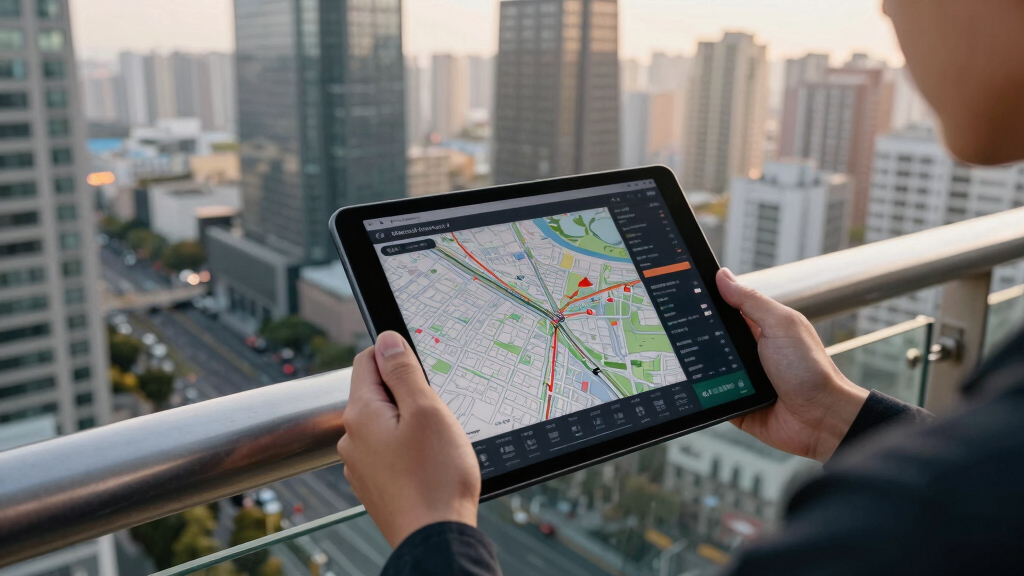
Wide-Area Motion Imagery (WAMI) is revolutionizing city surveillance by enabling authorities to monitor entire urban areas in real-time, capturing every vehicle and pedestrian movement across several square kilometers. This technology’s ability to record and archive all activity makes it one of the most significant surveillance tools of the last two decades, with broad implications for security and privacy.
WAMI systems, such as DARPA’s ARGUS-IS, utilize an array of thousands of cameras to produce gigapixel images covering large urban areas from high altitudes. These images are processed through complex pipelines that detect, track, and archive moving objects, allowing analysts to rewind and scrutinize past events with precision. The system’s capacity to resolve objects as small as six inches across from 17,500 feet altitude exemplifies its detailed coverage.
Operationally, WAMI is mounted on aircraft, drones, and other platforms, providing persistent surveillance regardless of day or night conditions. Its primary military use includes network discovery and border security, but civilian applications have expanded to wildfire mapping and disaster response. Despite its strengths, WAMI faces physical and operational limitations, including weather dependence, the need for overhead loitering platforms, and high operational costs.
To overcome some of these constraints, WAMI is increasingly paired with synthetic aperture radar (SAR), which can see through clouds, smoke, and darkness. This sensor fusion enables layered sensing, combining optical detail with all-weather, deep-denial coverage, enhancing overall surveillance capabilities.
The eye over the city: how Wide-Area Motion Imagery works — and where it goes blind
A normal drone sees through a soda straw. WAMI watches an entire city at once, tracks every mover, and records it all for forensic rewind. Immense reach — with hard limits that make radar and AI its necessary partners.
- City-scale motion, fine detail
- Forensic rewind
- Cloud / smoke / dark degrade it
- Needs a platform loitering overhead
sensing
+ AI
- Sees through cloud & total dark
- Tasked over denied airspace
- Persistent, wide-area from orbit
- Sovereign · on-prem · air-gap
The same archive that traces a bomber to a safe house can trace anyone home — retroactively, without prior suspicion. Baltimore’s secret 2016 deployment led to a 2021 federal ruling that persistent aerial tracking violated the Fourth Amendment. The security value is real; so is the mass-surveillance risk. Who owns the sensor, the archive, and the AI is the accountability question.
WAMI’s power is the archive and the AI reading it; its weakness is weather, airspace, and oversight. The mature posture isn’t optical-vs-radar or capability-vs-liberty — it’s layered sensing (optical WAMI + all-weather SAR), AI-enabled exploitation, and sovereign, auditable control of the whole chain. WAMI shows what a persistent eye can do with clear skies and owned airspace; for the cloud, the night, and the denied area, the radar layer is where the resilient coverage lives.
Implications of WAMI for Urban Security and Privacy
WAMI’s ability to monitor entire cities in real-time offers significant advantages for law enforcement, border security, and disaster management by providing comprehensive situational awareness. However, it also raises critical governance and privacy concerns, as the technology’s extensive data collection could impact civil liberties. Its reliance on AI for data processing amplifies questions about oversight, accuracy, and potential misuse.
high-resolution wide-area surveillance camera
As an affiliate, we earn on qualifying purchases.
As an affiliate, we earn on qualifying purchases.
Evolution and Deployment of Citywide Surveillance Technologies
The origins of WAMI trace back to early 2000s projects like Lawrence Livermore’s Sonoma program. It transitioned to military use with systems like DARPA’s ARGUS-IS, deployed on drones and aircraft in Iraq and Afghanistan. Over two decades, WAMI evolved from experimental rigs to widespread, proliferating sensors integrated into military and civilian operations. Its current applications include border security, wildfire mapping, and disaster response, with ongoing developments aimed at increasing coverage and integration with other sensor modalities.
“The real power of WAMI lies in its ability to archive and analyze vast amounts of data, but it’s limited by weather, platform availability, and costs.”
— Defense industry expert
As an affiliate, we earn on qualifying purchases.
Current Limitations and Governance Challenges of WAMI
While WAMI’s technical capabilities are well-documented, questions remain about its deployment scale, oversight, and privacy protections. The extent of civilian use, legal frameworks governing its deployment, and the accuracy of AI-driven analysis are still developing topics, with ongoing debates and legal cases addressing these issues.
synthetic aperture radar (SAR) device
As an affiliate, we earn on qualifying purchases.
As an affiliate, we earn on qualifying purchases.
Future Developments and Integration of WAMI Technologies
Advances are expected in sensor miniaturization, AI analysis, and sensor fusion, enhancing WAMI’s coverage and reliability. Integration with satellite-based SAR and other modalities will likely expand its operational envelope, making citywide surveillance more comprehensive and resilient. Policymakers and technologists are also working to establish governance standards to address privacy and ethical concerns.
As an affiliate, we earn on qualifying purchases.
Key Questions
How does WAMI differ from traditional surveillance cameras?
WAMI covers entire city areas in a single frame, unlike traditional cameras that focus on narrow fields of view. It records and archives all activity for later analysis, providing a forensic capability that standard cameras cannot match.
What are the main limitations of WAMI technology?
WAMI relies on optical sensors that are affected by weather, darkness, and smoke. It requires overhead platforms within reach of the target area, which can be contested or denied, and involves high operational costs.
How is WAMI used outside military applications?
civilian uses include wildfire mapping, disaster response, and border security, where its wide coverage and detailed tracking improve situational awareness and response capabilities.
What are the privacy concerns associated with WAMI?
The extensive data collection and archiving raise questions about civil liberties, oversight, and potential misuse, especially as the technology becomes more widespread and integrated with AI analysis.
Source: ThorstenMeyerAI.com
Fall Picks
fall essentials
As an affiliate, we earn on qualifying purchases.