
📊 Full opportunity report: Designing Consent Workflows For Kid-Facing Products on IdeaNavigator AI — validation score, market gap, and execution plan.

Get smart everyday buys delivered free — and shop member deals
- Fast, free delivery on millions of items
- Access to Prime Big Deal Days deals on October 6–7
- Prime Video, Amazon Music and more included
TL;DR
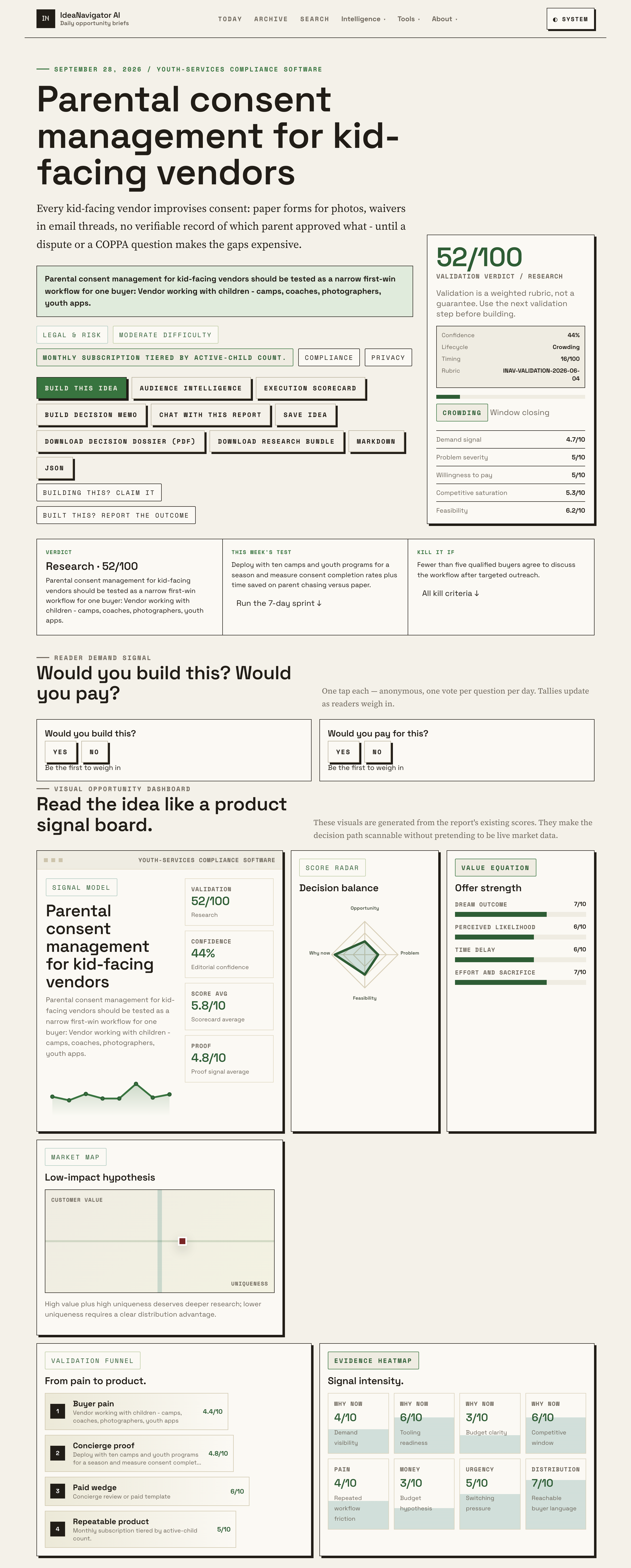
IdeaNavigator AI describes a proposed parental consent platform for camps, coaches, photographers and youth apps. The concept includes phone-based forms, per-child records and audit exports; no product launch, pilot findings or buyer commitments are reported.
IdeaNavigator AI has outlined a proposed parental consent tool for camps and other organizations that work with children, aiming to replace scattered paper forms and email approvals with phone-based workflows and searchable records. The proposal identifies a potential product opportunity, but does not report a launched service, customer commitments or pilot results.
The concept is aimed at camps, coaches, photographers and youth apps that collect permissions for matters such as photo use, data collection, medical information and liability. IdeaNavigator AI says these organizations often assemble consent processes themselves, leaving approvals spread across forms and email threads and making it difficult to establish which parent approved which use.
The proposed minimum product would let vendors provide branded consent forms parents can complete on a phone. It would keep a consent ledger for each child, track when permission expires, apply identity checks according to the perceived risk of a request, and generate an audit export. The proposal does not specify how identity checks would work or define the risk tiers.
For revenue, IdeaNavigator AI suggests monthly subscriptions priced by the number of active children. Its suggested validation step is a season-long deployment with ten camps or youth programs, measuring how often families complete consent forms and how much staff time is saved chasing approvals compared with paper processes. No such deployment or results are reported.
A Record of Each Parent’s Approval
For organizations serving children, a consistent record could make it easier to see which parent gave permission, for what purpose and for how long. That matters when a photo, piece of personal information or medical detail is used, and when a family later questions whether a particular use was authorized. The proposed audit export is intended to make those records easier to retrieve.
The operational case is also testable: staff at camps and youth programs routinely need to collect forms from families before activities begin. A phone-based workflow could reduce manual follow-up, but the proposal offers no measured completion rate, time saving or evidence of demand. Those outcomes would need to be established in the suggested pilot.
Any compliance benefit would depend on how the product is designed and used. A digital ledger does not by itself establish that consent was valid, that the right adult approved it, or that an organization met every legal requirement. The proposal names privacy regulation and disputes over children’s data and images as drivers, but does not provide a legal assessment or claim that the product would guarantee compliance.
From Paper Forms to a Pilot
The idea addresses a familiar administrative pattern in youth services: different activities can require different permissions, while small organizations may use separate paper forms, email exchanges or other informal records. IdeaNavigator AI frames that fragmentation as a potential business problem because staff may struggle to retrieve proof of approval when a parent raises a concern or an organization faces a privacy question.
The proposal points to changing children’s privacy rules, including updates to the U.S. Children’s Online Privacy Protection Act (COPPA) and state laws, as part of the rationale for exploring the product. It does not identify specific provisions, jurisdictions or enforcement actions, so it does not establish how a particular vendor would be affected. Requirements can vary based on the service and the information collected.
Rather than describe a company or product already in market, the outline recommends testing one narrow workflow with ten camps and youth programs for a season. It proposes comparing consent completion and staff time spent following up against paper processes. No participating organizations, trial dates or baseline measurements are named.
Product and Demand Remain Untested
No launch, customer adoption or pilot evidence is reported. It is unclear whether any vendor has agreed to test the concept, what a finished product would cost, or whether organizations would pay according to active-child counts. The suggested ten-program trial is a validation plan, not evidence that a trial has taken place.
The proposal also leaves product and privacy questions open. It does not explain how the service would verify a parent’s identity, handle cases involving multiple guardians, protect sensitive records, limit staff access, or process withdrawals and expired permissions. It provides no technical specifications, security review or legal analysis. Those details would affect whether the workflow is useful and appropriate for different kinds of consent.
Ten Programs Would Test the Idea
The next step proposed by IdeaNavigator AI is a seasonal trial with ten camps and youth programs. The suggested measures are consent completion rates and staff time spent following up with parents compared with paper-based processes. Results could help show whether the workflow solves an operational problem for vendors, but no timetable or trial participants have been announced.
Until a pilot or product release is reported, the concept remains an early opportunity outline. Details about pricing, identity checks, data safeguards, legal coverage and buyer interest remain to be established.
Source: IdeaNavigator AI
Key Questions
Has a parental consent platform been launched?
No launch is reported. IdeaNavigator AI describes a proposed product and a possible validation trial.
Who is the proposed tool for?
The concept targets camps, coaches, photographers and youth apps that need parents to approve uses of children’s photos, data or other information.
What features are proposed?
The outline calls for phone-based branded forms, per-child consent records, expiry tracking and audit exports, with identity checks suited to the perceived risk of each request.
How would the idea be tested?
IdeaNavigator AI proposes a season-long trial with ten camps and youth programs, measuring form completion and staff time spent following up compared with paper processes. No trial results are available.
Source: IdeaNavigator AI
Fall Picks
fall essentials
As an affiliate, we earn on qualifying purchases.