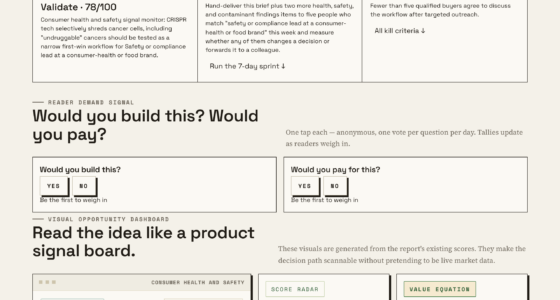

📊 Full opportunity report: Europe Regulated the Interface and Forgot to Build the Engine on ThorstenMeyerAI.com — validation score, market gap, and execution plan.

Get smart everyday buys delivered free — and shop member deals
- Fast, free delivery on millions of items
- Access to Prime Big Deal Days deals on October 6–7
- Prime Video, Amazon Music and more included
TL;DR
European regulators concentrated on controlling AI interface elements, such as cookie banners, but failed to invest in or develop advanced AI models. This oversight has left Europe behind in AI innovation and capability, raising concerns about future competitiveness.
Europe’s focus on regulating AI interfaces, exemplified by cookie banners and consent management, has come at the expense of developing the underlying AI technology itself. As a result, the continent now trails behind global leaders in AI capability and innovation, raising questions about its future competitiveness in the field.
European regulators have concentrated on creating rules for AI interfaces, such as the cookie banners that dominate the web experience, but have largely neglected investing in or fostering the development of advanced AI models. The European AI Act, introduced as the world’s first comprehensive AI regulation, aimed to set rules but did not address building the core technology. Meanwhile, the global AI landscape has shifted dramatically, with American and Chinese companies leading in both capability and scale.
European AI initiatives, such as the startup Mistral, remain mid-tier players, with limited funding and capability compared to US giants like OpenAI and Chinese models like Zhipu’s GLM 5.2, which outperforms many Western models at a fraction of the cost. Europe’s AI ecosystem lacks the talent, capital, and strategic focus needed to compete at the frontier, with most of its efforts focused on regulation rather than innovation.
Europe regulated the interface and forgot the engine
The cookie banner is the most-used European software of the decade. While Brussels perfected the consent pop-up, the frontier was built elsewhere — and now, in H2 2026, Europe wants to buy back in without changing what put it on the outside.
This isn’t about whether privacy or safety matter — they do. It’s that Europe mistook regulating the interface for having a seat at the table. You can’t grant your way out of a structural problem while keeping the structure — the laws, the capital gaps, the energy costs, the talent drain all left untouched. The fix isn’t another framework: it’s open weights as a product, sovereign compute on affordable power, real capital plumbing — and to stop mistaking a check for a strategy.
Implications of Europe’s Technological Stagnation
This situation puts Europe at risk of losing influence in the emerging AI-driven geopolitical landscape. While the continent has established regulatory frameworks, it has not built the technological foundation necessary to participate meaningfully in AI’s future. The lack of advanced models and talent could lead to dependency on non-European technology, diminishing sovereignty and economic competitiveness.
As an affiliate, we earn on qualifying purchases.
Europe’s Regulatory Approach vs. Technological Investment Gap
Europe has historically prioritized regulation over direct technological development, exemplified by the AI Act and the dominance of cookie banners that serve as symbols of regulatory focus. Despite this, the continent’s AI industry remains underfunded and underpowered compared to US and Chinese counterparts. The US and China have aggressively invested in building frontier models, with Chinese companies like Zhipu shipping models that outperform many Western models at a lower cost, while Europe’s AI startups struggle to raise capital and scale.
This divergence reflects structural choices: Europe’s fragmented capital markets, regulatory burdens, and lack of large-scale investment have hindered the growth of its AI sector. Consequently, Europe is now on the sidelines of the global AI race, with few models capable of competing at the highest levels of capability and security.
“We are building models with limited funding and talent, and the global leaders are shipping free models that outperform ours.”
— European AI startup CEO
As an affiliate, we earn on qualifying purchases.
Unclear Future of Europe’s AI Leadership
It remains uncertain whether Europe will shift its focus towards investing in core AI technology or continue to rely on regulation. The extent to which European policymakers will realize the need for a strategic technological push is still unclear, as is the potential for new funding initiatives or partnerships to bridge the capability gap.
As an affiliate, we earn on qualifying purchases.
Next Steps for Europe’s AI Strategy
European policymakers and industry leaders are expected to debate whether to increase investment in AI research and development or to focus solely on regulation. Future initiatives might include targeted funding for AI startups, fostering international collaborations, or revising regulations to better support innovation. The outcome will determine Europe’s ability to regain a competitive foothold in AI technology.
As an affiliate, we earn on qualifying purchases.
Key Questions
Why has Europe focused more on regulating AI rather than developing it?
Europe prioritized regulation to address privacy, safety, and ethical concerns, but this approach overlooked the importance of investing in and building the underlying AI technology itself.
What are the risks of Europe falling behind in AI capability?
Falling behind could lead to dependency on non-European AI technology, loss of economic influence, and diminished sovereignty in critical technological sectors.
Can Europe catch up in AI development?
It is uncertain; success would require significant shifts in policy, increased funding, and strategic focus on building core AI capabilities rather than only regulating interfaces.
How does China’s AI development compare to Europe’s?
China is shipping near-frontier models for free, with capabilities surpassing many Western models at a fraction of the cost, highlighting Europe’s lag in technological innovation.
What role will regulation play in Europe’s future AI landscape?
Regulation will remain important for safety and privacy, but without technological development, it may only serve as a superficial control measure rather than a driver of innovation.
Source: ThorstenMeyerAI.com
Halloween Picks
halloween
As an affiliate, we earn on qualifying purchases.