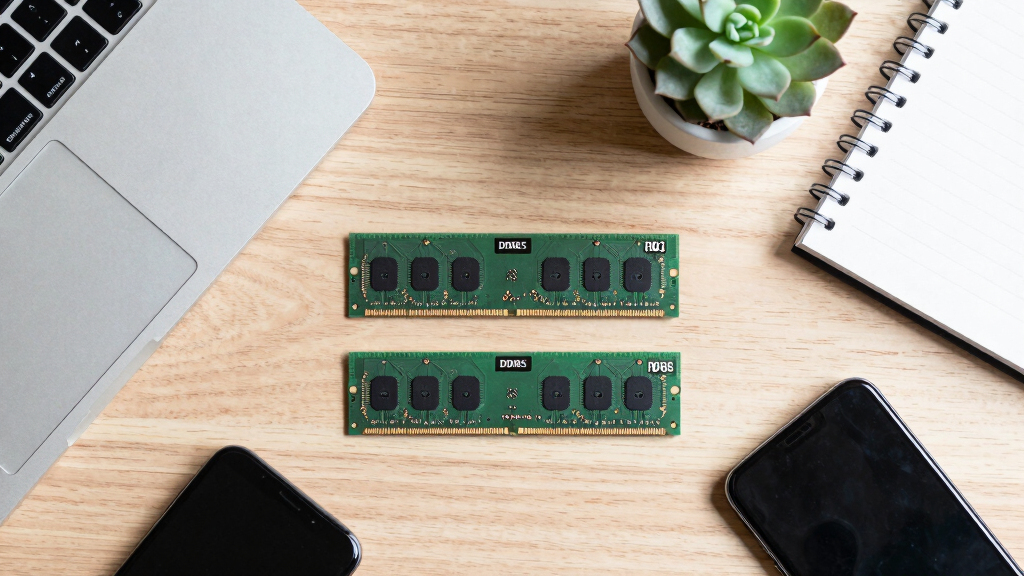

📊 Full opportunity report: DDR5 Now, DDR6 Soon: A Buyer’s Field Guide on ThorstenMeyerAI.com — validation score, market gap, and execution plan.

Get smart everyday buys delivered free with Prime
- Fast, free delivery on millions of items
- Prime Video, Amazon Music and more included
- Member-only deals all year
TL;DR
With DDR5 prices remaining high and DDR6 still in development, experts recommend buying DDR5 now for current needs. DDR6 is not yet ready for mainstream, and waiting may delay upgrades without savings.
Memory market experts advise that consumers should purchase DDR5 memory now for current builds, as DDR6 remains at least two years away from mainstream adoption. The advice counters typical market patience, emphasizing that waiting for DDR6 could delay upgrades and incur higher costs, while DDR5 prices are unlikely to drop significantly before 2028.
Recent industry analysis indicates that DDR5 prices have stabilized at high levels, with forecasts suggesting meaningful relief only around 2028. Meanwhile, DDR6, which promises significant performance improvements, is not expected to reach mainstream desktops until 2027, with initial adoption in enterprise and AI servers around 2026–27. DDR6 introduces a new physical form factor, CAMM2, and a radically different architecture, including increased bandwidth and more sub-channels, but it requires entirely new CPUs, chipsets, and modules.
Experts warn that waiting for DDR6 to arrive could mean missing out on current platform improvements and incurring delays. Moreover, the cost of DDR6 modules will be substantially higher initially, with estimates indicating prices could be 2–3 times those of DDR5 at launch. The recommendation is to build with DDR5 now, focusing on configurations like DDR5-6000 CL30, which balances performance and cost, and to avoid overbuying capacity, as the current market has set record-high prices for memory modules.
DDR5 now, DDR6 soon
A buyer’s field guide. The 20-year instinct — wait for prices to drop, or wait for the next generation — is broken this cycle. Buy the DDR5 you actually need now; don’t wait for DDR6. Here’s the reasoning.
Driven to end-of-life, production slashed. Same money, dead-end socket. Leave a working DDR4 box alone — but never start a new build on DDR4 to “save.”
A framework, not a gamble. Buy the DDR5 you need now, at the sweet spot, in the capacity you’ll actually use — don’t buy DDR4, don’t wait for DDR6. The two costliest mistakes in this market are the ones that feel prudent: waiting for a price drop that isn’t coming, and waiting for a next-gen part that launches dearer than what’s on the shelf. Next: The SSD Squeeze.
Why Immediate DDR5 Purchase Is the Best Strategy
This guidance matters because many consumers face the dilemma of whether to buy now or wait for DDR6. Given the current market conditions, waiting offers little benefit: DDR5 prices are unlikely to fall significantly before 2028, and DDR6 will not be a practical upgrade path for most users until at least 2027. Building with DDR5 now ensures users can leverage current platform advancements without paying a premium for future technology that remains unavailable and unproven in mainstream systems. For gamers, content creators, and general users, this means better value and performance today, rather than delaying upgrades and risking higher costs later.
As an affiliate, we earn on qualifying purchases.
Current Market Conditions and Future DDR6 Roadmap
The memory market has experienced record-high prices due to supply shortages and increased demand, with DDR5 prices stabilizing but remaining elevated. Industry forecasts indicate that DDR5 will remain expensive until 2028, with minimal price drops. DDR6, announced as a next-generation standard, is still in development, with initial deployment limited to enterprise and high-performance computing environments. The new architecture promises higher bandwidth and efficiency but demands entirely new hardware, making early adoption costly and complex. The phased rollout is expected to start around 2026–27, with broad mainstream adoption not until 2030.
Manufacturers and industry analysts emphasize that DDR6 is a roadmap, not an immediate product, and early adopters will face limited capacities, higher prices, and potential stability issues. Meanwhile, DDR4 is effectively phased out, and building new systems on DDR4 is discouraged, as it will become obsolete in the near future.
“DDR6 introduces a new form factor and architecture, but early modules will be expensive and limited in capacity.”
— Hardware manufacturer representative
As an affiliate, we earn on qualifying purchases.
Uncertainties Surrounding DDR6 Adoption and Timing
While DDR6 is technically progressing towards standardization, it remains uncertain when fully compatible modules and CPUs will become available for mainstream desktops. The exact pricing, capacities, and stability of early DDR6 modules are still unknown, and the market could see delays beyond current forecasts. Additionally, the impact of DDR6 on gaming performance is expected to be minimal, making it less relevant for most consumers in the near term.
As an affiliate, we earn on qualifying purchases.
Next Steps for Consumers and Industry Watchers
Consumers should focus on building or upgrading systems with DDR5 now, selecting configurations like DDR5-6000 CL30 for optimal value. Monitoring JEDEC standards and motherboard compatibility lists will be key to tracking DDR6’s progress. Industry analysts will continue to watch for early module releases, pricing trends, and the transition timelines for CPUs and chipsets supporting DDR6. Expect the first mainstream DDR6-compatible platforms to appear around 2027, with broader adoption not until 2030.
As an affiliate, we earn on qualifying purchases.
Key Questions
Should I buy DDR4 now to save money?
No. DDR4 is being phased out, and building a new system on DDR4 in 2026 will likely lead to obsolescence and limited upgrade paths. It’s better to invest in DDR5 for future-proofing.
Is DDR6 worth waiting for?
For most users, no. DDR6 is still in development, will be expensive initially, and is not expected to arrive in mainstream desktops until 2027. It is mainly relevant for specialized workloads like AI or scientific computing.
What DDR5 configuration offers the best value?
DDR5-6000 with CL30 timings is considered the sweet spot for both AMD and Intel platforms, providing a good balance of performance and cost.
Will DDR6 significantly improve gaming performance?
Likely not. DDR6’s higher bandwidth benefits are more relevant for data-intensive tasks than gaming, where GPU and CPU performance are more critical.
When should I expect DDR6 to become affordable?
Early adopters might face high prices in 2026–27, but widespread affordability probably won’t occur until around 2030, similar to DDR4’s adoption curve.
Source: ThorstenMeyerAI.com
Halloween Picks
halloween
As an affiliate, we earn on qualifying purchases.