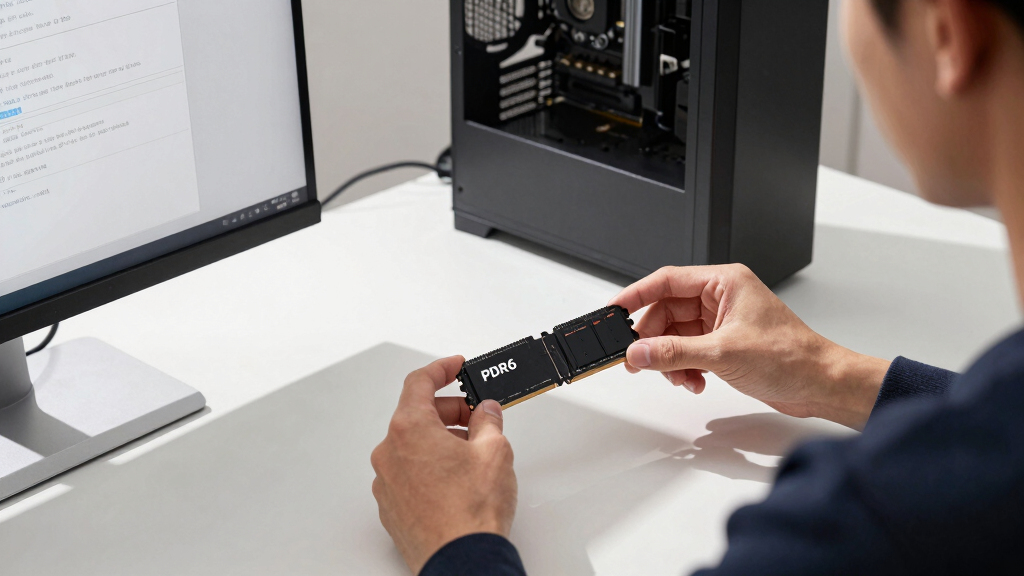

📊 Full opportunity report: DDR5 Now, DDR6 Soon: A Buyer’s Field Guide on ThorstenMeyerAI.com — validation score, market gap, and execution plan.

Get smart everyday buys delivered free with Prime
- Fast, free delivery on millions of items
- Prime Video, Amazon Music and more included
- Member-only deals all year
TL;DR
Despite the hype, DDR6 is not yet ready for mainstream use in 2026. Prices for DDR5 remain high, but buying now is advised for most users. Waiting for DDR6 may delay upgrades without saving money.
Market conditions in 2026 strongly favor purchasing DDR5 memory now, as DDR6 remains in development and will not be available for mainstream desktops until 2027. Experts agree that waiting for DDR6 is unlikely to provide cost savings or performance benefits in the near term, making current DDR5 options the best choice for most users.
Prices for DDR5 memory remain elevated in 2026, but forecasts suggest that significant relief is not expected until 2028. Meanwhile, DDR6, which promises doubled bandwidth and new form factors, is still in the early stages of development, with initial deployment limited to enterprise and AI servers in 2026–27. Mainstream desktops and laptops are not expected to see DDR6 until 2027, with broad adoption not until around 2030.
For consumers building or upgrading PCs in 2026, the recommended configuration is DDR5-6000 with CL30 timings, which balances performance and cost. Capacity planning should focus on actual workload needs—32GB for gaming and general use, 64GB for content creation—rather than overbuying capacity for future-proofing, which is unlikely to pay off soon. The misconception that DDR4 remains a cost-effective option is false; DDR4 production is declining, and DDR4 modules now cost roughly the same or more per gigabyte than DDR5, with no future platform support.
Regarding DDR6, it introduces a new architecture with four 24-bit sub-channels, higher speeds (up to 17,600 MT/s), and a new physical form factor (CAMM2). However, DDR6 is not backward compatible and will require entirely new CPUs, chipsets, and modules. Its rollout is staged, starting with enterprise and AI applications, then high-end laptops and desktops, with widespread consumer adoption not expected before 2030. Early adopters face potential issues like unstable profiles and limited capacities.
DDR5 now, DDR6 soon
A buyer’s field guide. The 20-year instinct — wait for prices to drop, or wait for the next generation — is broken this cycle. Buy the DDR5 you actually need now; don’t wait for DDR6. Here’s the reasoning.
Driven to end-of-life, production slashed. Same money, dead-end socket. Leave a working DDR4 box alone — but never start a new build on DDR4 to “save.”
A framework, not a gamble. Buy the DDR5 you need now, at the sweet spot, in the capacity you’ll actually use — don’t buy DDR4, don’t wait for DDR6. The two costliest mistakes in this market are the ones that feel prudent: waiting for a price drop that isn’t coming, and waiting for a next-gen part that launches dearer than what’s on the shelf. Next: The SSD Squeeze.
Implications of Buying DDR5 Instead of Waiting for DDR6
For most consumers, purchasing DDR5 now is the practical choice, as DDR6’s arrival is years away and involves significant platform upgrades. Delaying purchase to wait for DDR6 could result in missing out on current improvements in CPU, GPU, and platform technology, which evolve faster than memory standards. For users with specific needs—such as long-term workstations or bandwidth-intensive AI tasks—DDR6 may eventually be beneficial, but for typical gaming and general use, DDR5 remains the best option.
As an affiliate, we earn on qualifying purchases.
2026 Memory Market and Future DDR6 Development Timeline
The memory market in 2026 is characterized by high prices driven by supply shortages and increased demand. Historically, new memory standards like DDR4 and DDR5 took several years to become mainstream, with DDR4 launched in 2014 and widespread adoption by 2018. DDR6, announced as a significant upgrade, is still in the early stages of development, with initial deployment limited to enterprise and AI applications. Consumer adoption is projected to begin around 2027, with full market penetration not expected until 2030.
Manufacturers have emphasized that DDR6 will require new hardware, including CPUs and chipsets, making early adoption costly and complex. Meanwhile, DDR5 has matured, with stable, high-performance modules available at a range of price points, making it the logical choice for current builds.
“DDR6 introduces a new architecture with higher speeds and a new form factor, but it will only be available on new platforms that support it, starting around 2027.”
— Hardware manufacturer spokesperson
As an affiliate, we earn on qualifying purchases.
Uncertainties Surrounding DDR6 Availability and Pricing
While DDR6 is officially in development, precise timelines for its widespread release and price points remain uncertain. Early-stage modules may be unstable or limited in capacity, and actual performance gains in real-world applications are still to be validated. The adoption curve could be slower or faster than current projections, and unforeseen technical challenges may influence its market entry.
As an affiliate, we earn on qualifying purchases.
Next Steps for Consumers Considering Memory Upgrades in 2026
Consumers should focus on purchasing DDR5 modules that meet their performance needs, particularly DDR5-6000 CL30 kits. Monitoring JEDEC standards and motherboard compatibility lists will help identify when DDR6 modules become available and stable for mainstream use. For those building long-term systems or involved in bandwidth-heavy tasks, planning for a future DDR6 upgrade around 2027–28 may be worthwhile, but for most, current DDR5 remains the best choice.
As an affiliate, we earn on qualifying purchases.
Key Questions
Is DDR4 a good choice for new builds in 2026?
No. DDR4 is nearing end-of-life, and current prices for DDR4 are comparable to DDR5. Building on DDR4 now limits future upgrade options and platform support, so DDR5 is the recommended standard.
When will DDR6 be available for mainstream desktops?
DDR6 is expected to launch in enterprise and AI applications in 2026–27, with mainstream desktop support arriving around 2027, and full adoption not until approximately 2030.
Should I buy more than 32GB of DDR5 RAM in 2026?
Only if your workload demands it, such as content creation or heavy multitasking. For typical gaming and general use, 32GB remains sufficient, and overbuying may lead to unused capacity and higher costs.
What are the risks of waiting for DDR6?
Waiting could mean missing out on current platform improvements and paying a premium for early DDR6 modules, which may be unstable or limited in capacity. It also delays overall system upgrades.
Source: ThorstenMeyerAI.com
Halloween Picks
halloween
As an affiliate, we earn on qualifying purchases.