📊 Full opportunity report: GLP-1 Pharmacies And Direct Channels: Compare Stock And Costs on IdeaNavigator AI — validation score, market gap, and execution plan.

Get smart everyday buys delivered free — and shop member deals
- Fast, free delivery on millions of items
- Access to Prime Big Deal Days deals on October 6–7
- Prime Video, Amazon Music and more included
TL;DR
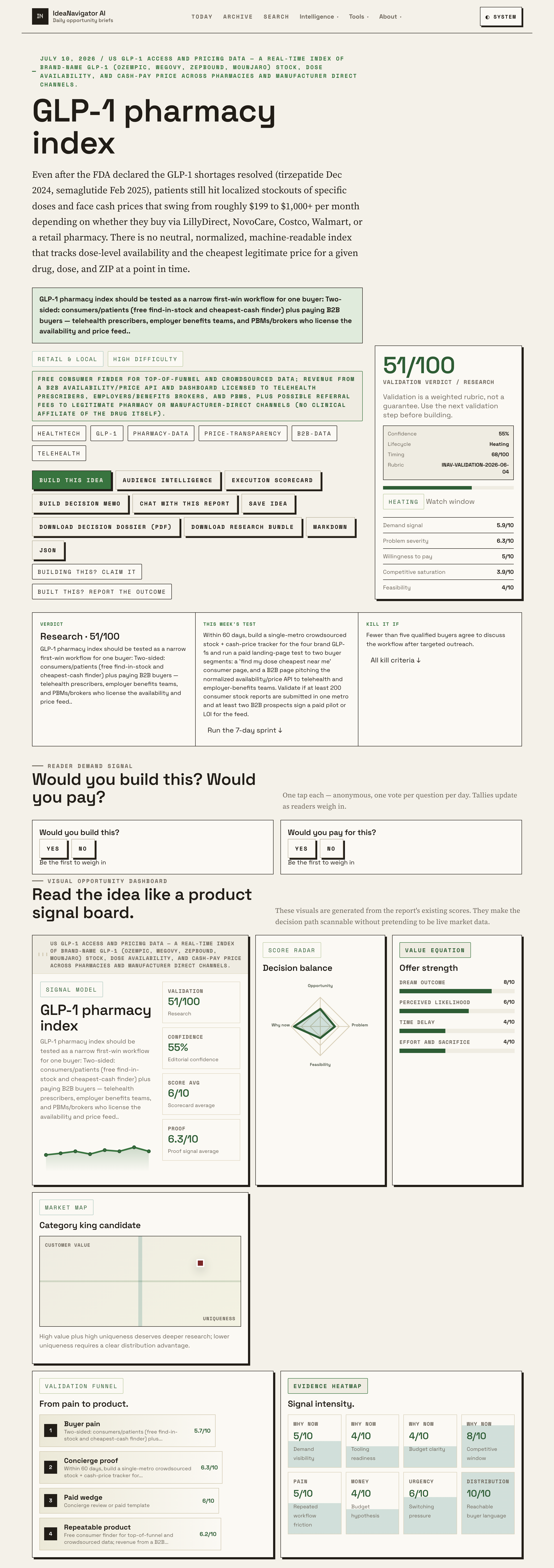
A proposal from IdeaNavigator AI argues that the GLP-1 market has shifted from a shortage problem to a fragmentation problem, with cash prices ranging from roughly $199 to more than $1,000 per month across channels. It proposes a two-sided index combining a free consumer stock-and-price finder with a paid B2B data feed. The concept remains unvalidated.
A new proposal from IdeaNavigator AI calls for building a GLP-1 pharmacy index — a neutral, machine-readable tracker of dose-level availability and the cheapest legitimate cash price for brand-name GLP-1 drugs such as Ozempic, Wegovy, Zepbound and Mounjaro across US pharmacies and manufacturer direct channels. The proposal responds to a market shift: with the FDA declaring GLP-1 shortages resolved (tirzepatide in December 2024, semaglutide in February 2025), the persistent problem is no longer nationwide supply but fragmented local stockouts and cash prices that swing from roughly $199 to more than $1,000 per month depending on where patients buy.
According to the proposal, no single neutral source currently normalizes dose-level availability and cash pricing across the channels patients actually use: LillyDirect, NovoCare, Costco and Walmart cash programs, and traditional retail pharmacies. Patients can still encounter localized stockouts of specific doses even though the drugs are officially off the FDA shortage list.
The proposed product has two sides. On the consumer side, a free web tool would let patients search by drug, dose and ZIP code to find in-stock pharmacies and the cheapest legitimate cash price, seeded with crowdsourced stock reports plus normalized public pricing from manufacturer direct sites and retailer cash programs. On the business side, the same availability-and-price dataset would be licensed as a B2B API and dashboard to telehealth prescribers, employer benefits teams, and PBMs or brokers.
The revenue model would rely on the B2B licensing, plus possible referral fees to legitimate pharmacy or manufacturer-direct channels. The proposal specifies that the consumer finder would remain free as a top-of-funnel tool and a source of crowdsourced availability data.
Why Employers and Telehealth Need This Data
The proposal’s timing argument rests on employer cost pressure. It states that employers report GLP-1s are roughly 20% of pharmacy spend, creating demand for cost-steering data that current sources do not provide in a normalized form. Telehealth prescribers, who increasingly write GLP-1 prescriptions fulfilled through cash-pay channels, would similarly benefit from knowing which doses are actually available before prescribing.
For patients, the price spread is the core issue. A difference between roughly $199 and $1,000+ per month for the same drug class is material for anyone paying cash, and the proposal argues that comparing channels today requires checking multiple sites manually with no guarantee the listed dose is in stock nearby.
From Shortage Crisis to Channel Sprawl
The GLP-1 supply picture changed quickly. The FDA removed tirzepatide from its shortage list in December 2024 and semaglutide in February 2025, according to the proposal. Those decisions triggered compounding deadlines that forced compounders out of the copycat market, removing a cheaper gray-market channel at the same time manufacturers launched competing direct cash-pay offerings.
The result, per the proposal, is a sprawl of prices and dose-level supply gaps across LillyDirect, NovoCare, Costco and Walmart cash programs, and the TrumpRx portal launched in February 2026 — with no single source that normalizes the picture. The proposal frames this as the opening for a neutral index, exactly as the market moved from a shortage problem to a fragmentation problem.
Unproven Demand and Data Reliability Risks
The proposal is a concept, not a launched product, and its demand assumptions are untested. Key open questions include whether crowdsourced stock reports can achieve enough density and accuracy to be useful at dose level, whether public price data from manufacturer and retailer sites can be normalized reliably given frequent changes, and whether telehealth or employer-benefits buyers will pay for a feed that alternatives such as GoodRx-style price layers partially cover.
The employer spend figure and the $199-to-$1,000+ price range are presented by IdeaNavigator AI without an underlying survey or dataset, and the article does not independently verify them. It is also unclear how such an index would handle referrer relationships with manufacturer direct channels without creating conflicts of interest, a risk the proposal acknowledges only by limiting referrals to legitimate channels.
A 60-Day, One-Metro Validation Test
The proposal sets out a specific validation plan: within 60 days, build a single-metro crowdsourced stock and cash-price tracker for the four brand GLP-1s and run paid landing-page tests aimed at two buyer segments — a consumer page pitched as ‘find my dose cheapest near me’ and a B2B page pitching the availability/price API to telehealth and employer-benefits teams.
The stated success thresholds are at least 200 consumer stock reports submitted in one metro and at least two B2B prospects signing a paid pilot or letter of intent. Whether those thresholds are met would determine whether the concept advances from proposal to product.
Source: IdeaNavigator AI
Key Questions
Are GLP-1 drugs still in shortage?
No, according to the FDA actions cited in the proposal: tirzepatide was declared resolved in December 2024 and semaglutide in February 2025. However, localized stockouts of specific doses can still occur at individual pharmacies.
Why do GLP-1 cash prices vary so much?
Prices differ by channel — LillyDirect, NovoCare, Costco and Walmart cash programs, and retail pharmacies each set their own cash pricing. The proposal reports a range of roughly $199 to more than $1,000 per month, though it does not publish the underlying data.
What exactly is the proposed GLP-1 pharmacy index?
A two-sided product: a free consumer tool for finding in-stock doses and the cheapest legitimate cash price by drug, dose and ZIP code, and a paid B2B API licensing the same availability and price data to telehealth prescribers, employers and PBMs.
Is this index available now?
No. It is a proposal from IdeaNavigator AI that has not been built or validated. The proposal defines a 60-day, single-metro test with specific thresholds before any build decision.
How would the index make money?
Primarily through B2B licensing of the availability and price feed to telehealth, employer-benefits and PBM customers, plus possible referral fees to legitimate pharmacy or manufacturer-direct channels. The consumer finder would stay free.
Source: IdeaNavigator AI
Fall Picks
fall essentials
As an affiliate, we earn on qualifying purchases.