📊 Full opportunity report: How IEP Negotiation Simulators Support Parents New To Advocacy on IdeaNavigator AI — validation score, market gap, and execution plan.

Get smart everyday buys delivered free — and shop member deals
- Fast, free delivery on millions of items
- Access to Prime Big Deal Days deals on October 6–7
- Prime Video, Amazon Music and more included
TL;DR
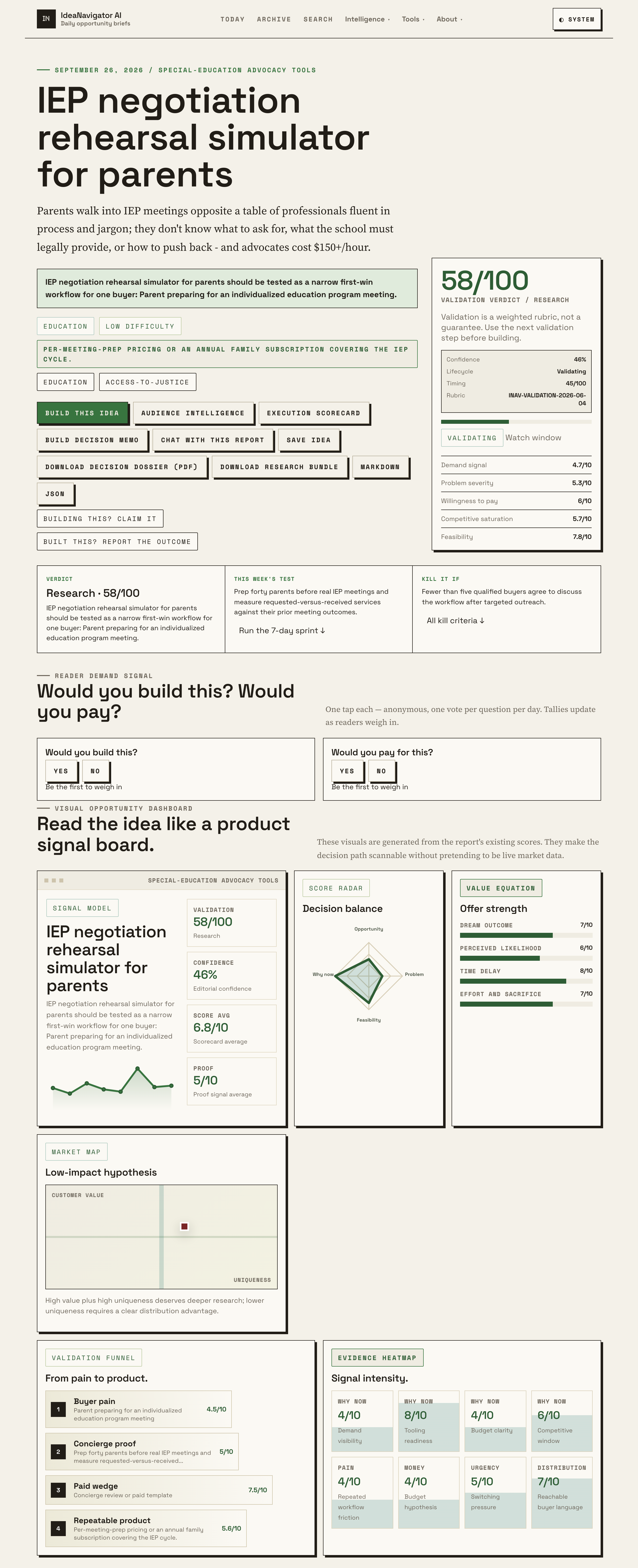
A product concept from IdeaNavigator AI proposes an IEP negotiation rehearsal simulator that role-plays special education meetings with parents before they attend the real thing. The concept responds to an information gap between parents and school districts, where professional advocates often charge $150 or more per hour. Effectiveness is unproven and would require validation against real meeting outcomes.
A newly published product blueprint from IdeaNavigator AI proposes using large language model role-play to help parents rehearse IEP (individualized education program) negotiations before they sit down with school officials, positioning AI simulation as an affordable stand-in for professional advocates who typically charge $150 or more per hour. The proposal, which remains a concept rather than a released product, targets a specific and growing pain point: parents entering high-stakes special education meetings without knowledge of entitlements, jargon or effective pushback strategies.
According to the blueprint, the core problem is structural. Parents walk into IEP meetings opposite a table of professionals who are fluent in the process and its terminology, while the parents often do not know what to ask for, what the school is legally required to provide, or how to respond when requests are declined. Hiring a professional advocate to close that gap is expensive, with rates commonly exceeding $150 per hour, according to IdeaNavigator AI’s assessment of the market.
The proposed minimum viable product would work in three stages. First, a parent would upload their child’s current IEP and evaluation reports. The simulator would then explain the family’s entitlements in plain language and generate a list of requests grounded in legal frameworks. Finally, the tool would role-play the meeting itself, including realistic pushback from a simulated school team, repeating until the parent can hold their positions under pressure.
On the business side, the blueprint proposes either per-meeting pricing or an annual family subscription covering the full IEP cycle, placing the product within the special-education advocacy tools market. The timing rationale, according to IdeaNavigator AI, is twofold: large language models have become capable enough to sustain realistic meeting role-play, and special-education identification rates keep climbing while district resources tighten, a combination the analysis says is making meetings more adversarial.
Why Parents May Want Rehearsal Tools
If such a simulator works as described, it could shift the balance of preparation in meetings where the school team typically holds an informational advantage. IEP meetings determine services, accommodations and placement for students with disabilities, and outcomes depend heavily on how effectively a parent can articulate and defend requests. A rehearsal tool priced well below advocate rates could widen access to that kind of preparation for families who cannot hire professionals.
The stakes are also rising. As the blueprint notes, growing identification rates combined with tightening district budgets create conditions in which schools have stronger incentives to limit services, and parents without negotiation experience are the least equipped to notice or contest gaps. A tool that translates evaluation reports into plain-language entitlements and legally grounded request lists addresses the earliest and most consequential stage of that disadvantage.
Top picks for "negotiation simulator support"
As an affiliate, we earn on qualifying purchases.
The Gap Between Parents and Districts
IEP meetings are a fixture of special education under U.S. federal disability education law, which entitles eligible students to individualized services. In practice, the meeting is a negotiation between a district team of educators, specialists and administrators and the child’s parents. Families often encounter the process for the first time at that table, and professional advocates — paid consultants who attend meetings and negotiate on parents’ behalf — have emerged as a paid workaround, at hourly rates that many families cannot sustain across annual review cycles.
The IdeaNavigator AI blueprint argues that recent improvements in large language model role-play make a simulated meeting realistic enough to be useful practice, which was not technically feasible with earlier conversational tools. It identifies the concept as a candidate for a “narrow first-win workflow” — a tightly scoped product that solves one problem for one type of buyer, in this case a parent with a meeting on the calendar.
Effectiveness Not Yet Demonstrated
No product has been launched and no validation results exist. The entire premise rests on two untested claims: that current language models can simulate an IEP meeting realistically enough to build transferable negotiation skill, and that rehearsal translates into better requested-versus-received service outcomes in real meetings.
The blueprint’s own validation plan — preparing forty parents and comparing their outcomes to prior meetings — has not been carried out, and there is no data on whether a sample of that size would be sufficient to detect an effect. Questions also remain about accuracy: a tool that misstates legal entitlements could leave parents worse prepared, and the blueprint does not describe how legal grounding would be verified or kept current across states, where special education rules vary.
The Forty-Parent Validation Test
The next step laid out in the blueprint is a direct validation study: recruit forty parents ahead of real IEP meetings, run them through the simulator, and compare the services they requested versus received against their own prior meeting outcomes. That comparison would provide the first evidence of whether rehearsal changes results.
Whether anyone builds and runs that study remains to be seen. If results were positive, the concept would move toward product development with per-meeting or subscription pricing; if negative, it would join the list of AI role-play ideas that work in demo but not in practice. No timeline for either path has been proposed.
Source: IdeaNavigator AI
Key Questions
Is an IEP negotiation simulator available to parents today?
No. The concept exists as a published product blueprint from IdeaNavigator AI. No launched product, pricing or user access has been announced.
How would the simulator work?
According to the blueprint, a parent would upload the current IEP and evaluation reports, receive plain-language explanations of entitlements and a legally grounded request list, then role-play the meeting with realistic pushback until they can hold their positions.
How much would it cost compared to hiring an advocate?
Professional advocates commonly charge more than $150 per hour, per the blueprint. The simulator is proposed as either per-meeting pricing or an annual family subscription, which would likely cost less — but no actual prices have been set.
Does rehearsing with AI actually improve IEP meeting outcomes?
This is unproven. The proposed validation would prepare forty parents and measure requested-versus-received services against their prior meetings, but that study has not been conducted.
What are the risks of relying on such a tool?
The main risk is accuracy: if the tool misstates what a school must legally provide, a parent could negotiate from a wrong position. Special education rules also vary by state, and the blueprint does not explain how legal grounding would be verified or kept current.
Source: IdeaNavigator AI
Fall Picks
fall essentials
As an affiliate, we earn on qualifying purchases.