📊 Full opportunity report: Small Business Owners Can Rehearse Speeches And Messages On Camera on IdeaNavigator AI — validation score, market gap, and execution plan.

Get smart everyday buys delivered free with Prime
- Fast, free delivery on millions of items
- Prime Video, Amazon Music and more included
- Member-only deals all year
TL;DR
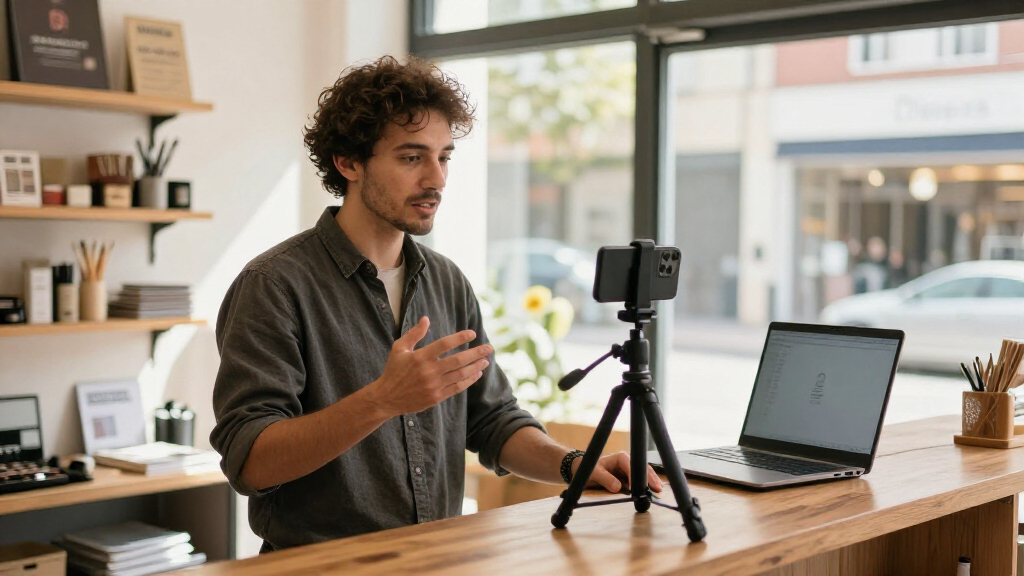
IdeaNavigator AI has outlined a proposed app to help business owners practice speaking on camera through short exercises and feedback on delivery. The concept has not been reported as a launched product; its proposed test would compare video publishing among a 100-owner cohort and a waitlist group.
IdeaNavigator AI has proposed a practice app for small business owners who know video could help their marketing but struggle to record themselves. The concept pairs brief speaking exercises with automated delivery feedback; it remains a proposal, and no launch, product performance or cohort results are reported.
The proposed first version would focus on one audience: business owners who freeze when recording. The concept identifies stumbling, self-criticism and repeated takes as barriers that can stop owners from posting at all. It argues that conventional public-speaking courses may not address the particular experience of speaking alone to a camera, though no research or user interviews are cited to establish how widespread the problem is.
The app would offer daily, two-minute prompted exercises, moving from reading prepared text toward speaking more freely. It could assess pace, filler words, eye line and energy, then show changes over time and use streaks to encourage continued practice. The intended endpoint is for users to move from rehearsals to recording actual business content. These are proposed features, not capabilities shown in a released app.
For validation, the proposal calls for a 30-day cohort of 100 owners and a waitlist control group. The suggested outcome is the share of participants who publish a first real video by day 45. The plan does not give a target success rate, recruitment method, measurement details or results. It also sketches a consumer subscription and a team tier for agencies coaching clients, without prices or evidence of willingness to pay.
IdeaNavigator AI · Early-stage concept
Small Business Owners Can Rehearse Speeches And Messages On Camera
A proposed practice app would use short daily speaking exercises and automated delivery feedback to help business owners move from camera rehearsal to publishing real business content. The product and its results remain unverified.
01 / The problem to solve
From camera freeze to a first take
The concept targets owners who see a role for video in marketing but struggle to record themselves. The prevalence of that problem has not been established by cited research or interviews.
Stumbling
Uncertainty while speaking can make a simple recording feel difficult to finish.
Self-criticism
Watching a take back may prompt owners to judge their delivery and start over.
Repeated takes
Retakes can consume time and make posting feel like a bigger step than practice.
02 / Proposed product flow
Build toward real business content
These are envisioned features for a possible first version, not capabilities demonstrated in a released app.
Read
Start with short prepared text to get comfortable on camera.
Practice
Use a daily, two-minute prompt for a quick rehearsal.
Review
See proposed feedback on pace, filler words, eye line and energy.
Publish
Progress toward recording and sharing actual business content.
03 / Validation hypothesis
Test whether rehearsal changes behavior
The key outcome is public posting, not simply better practice scores. No cohort findings or success target are reported.
A proposed cohort, with a waitlist comparison
Invite 100 owners into a 30-day practice cohort and compare with a waitlist group. By day 45, check what share published a first real video. Assignment, recruitment, tracking, privacy protections and the definition of “published” still need to be specified.
04 / Open questions
What remains unverified
The proposal outlines an opportunity and a test plan, but leaves important product, measurement and business details open.
Can feedback be trusted?
No AI system, accuracy checks, release schedule or recording storage and access policy is described.
Will practice lead to posting?
No results show reduced anxiety, more published videos or more effective marketing.
Who would pay first?
Individual subscriptions and an agency team tier are suggested, with no prices or willingness-to-pay evidence.
Traceability / From idea to evidence
The proof path
A useful early signal would connect regular rehearsal with publishing outside the app.
Key questions
Quick answers
What the current proposal says—and what it does not yet establish.
Is the app available now?
No launch is reported. IdeaNavigator AI describes a proposed product and test plan, not an available app.
Status · ProposalWho is it for?
Business owners who believe video may help their marketing but struggle to record themselves. An agency team tier is also proposed.
Audience · Owners and agenciesWhat would users practice?
Daily two-minute prompts, moving from reading prepared text toward more spontaneous speaking, with proposed feedback on delivery.
Routine · Short daily exercisesHow would the idea be tested?
A 30-day cohort of 100 owners and a waitlist comparison, measuring who publishes a first real video by day 45. No results are available.
Measure · First published videoTesting a Video Practice Workflow
The concept addresses a practical gap between knowing video may be useful and actually publishing it. For a small business owner, a private rehearsal tool could make the first recording feel more manageable without requiring a course or a live coach. Whether that support changes behavior, rather than merely increasing practice inside an app, is the central question the proposed test is meant to examine.
The proposed day-45 publishing measure focuses on an observable action outside the app. That matters because improved scores on pace or eye contact would not, by themselves, show that owners are reaching customers or using video more consistently. A comparison with a waitlist group could offer an initial point of reference, but the plan supplies no findings and does not specify how the groups would be assigned or tracked.
The suggested business model also points to two distinct buyers: individual owners and agencies supporting clients. Those groups may have different needs, including privacy expectations, coaching oversight and reporting. The proposal does not establish which audience would adopt the product first or whether either would pay for it.
Products Worth Considering

Logitech MX Brio Ultra HD 4K Webcam, Graphite

Canon imagePROGRAF PRO-1100 17-Inch Professional Wireless Inkjet Photo Printer

HP OfficeJet 250 Wireless Mobile All-in-One Inkjet Printer
As an affiliate, we earn on qualifying purchases.
From Camera Anxiety to Rehearsal
The proposal frames the timing around video-first marketing pressure reaching businesses of different sizes and the use of multimodal AI to assess aspects of on-camera delivery. It does not provide market data, cite specific technology providers or show that a system can reliably measure the listed traits in varied recording conditions.
Its distinction from general public-speaking training is the setting: a person practicing alone, recording and reviewing short clips. The envisioned routine starts with reading, then progresses toward improvised speaking and real content. This is a product hypothesis rather than evidence that existing training fails to help business owners.
IdeaNavigator AI presents the app as an early-stage opportunity in communication skills training. The material describes a possible minimum viable product and a way to test it; it does not identify a named company, founder, release date or existing customer base.
Product and Trial Details Pending
No app launch or completed test is reported. The proposal does not name a developer, provide a release schedule, describe the AI system or explain how feedback would be checked for accuracy. It also gives no details on how recordings would be stored, who could access them, or how participant privacy would be protected.
The planned comparison is not yet described as a formal study. It is unclear how owners would enter the cohort, how a waitlist group would be formed, what counts as a published video, or whether outside factors such as prior video experience would be accounted for. No evidence is provided that the app would reduce anxiety or lead to more effective marketing.
A Cohort Would Test Adoption
The next proposed step is to recruit 100 business owners for a 30-day cohort, alongside a waitlist comparison group, and check by day 45 how many have published a first real video. That test could offer an early indication of whether structured practice is followed by public posting, but the proposal gives no confirmed start date, recruitment channel or reporting timetable.
Further details would be needed to judge the result, including group assignment, baseline video activity, privacy protections and the definition of a completed publication. Until a test is conducted and its findings reported, the app’s ability to help owners get on camera—and the viability of its subscription or agency tiers—remains unverified.
Source: IdeaNavigator AI
Key Questions
Is the camera-practice app available now?
No launch is reported. IdeaNavigator AI describes a proposed product and test plan, not an available app.
Who is the proposed app for?
It is aimed at business owners who know video may matter for marketing but struggle to record themselves. An agency team tier is also proposed for coaching clients.
What would users practice?
The suggested routine uses two-minute daily prompts, progressing from reading to more spontaneous speaking. Proposed feedback would cover pace, filler words, eye line and energy.
How would the idea be tested?
The proposal suggests a 30-day group of 100 owners and a waitlist control, measuring who publishes a first real video by day 45. No results or full study plan are available.
Source: IdeaNavigator AI