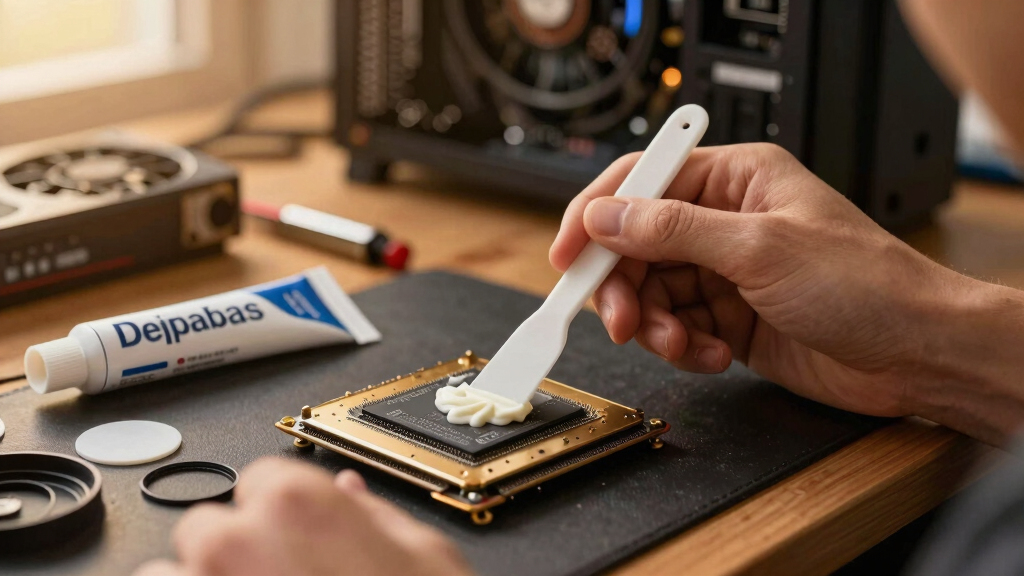

📊 Full opportunity report: Best Thermal Paste and Pads for High-TDP GPUs on ThorstenMeyerAI.com — validation score, market gap, and execution plan.
Open a free Amazon Business account
Business pricing, bulk buying and tax-exempt orders.
Create a free accountAs an affiliate, we earn on qualifying purchases.
TL;DR
This article reviews the best thermal interface materials for high-power GPUs running continuously, emphasizing long-term stability over initial temperature drops. Honeywell PTM7950, Arctic MX-6, Noctua NT-H2, and Thermal Grizzly Kryosheet are highlighted as top choices based on application needs.
Honeywell PTM7950 phase-change material is identified as the best thermal interface material for high-TDP GPUs running continuously, due to its resistance to pump-out and long-term stability under sustained heat.
Traditional thermal pastes like Kryonaut excel in initial cooling but tend to dry out over prolonged high-temperature operation, leading to increased GPU temperatures over time. For 24/7 workloads such as AI inference, materials that resist pump-out—where paste is expelled from between the die and heatsink—are essential. Honeywell PTM7950, a phase-change material, is recommended because it remains stable over years of continuous use, maintaining low thermal resistance. Arctic MX-6 offers a reliable, easy-to-apply traditional paste with a lifespan of 8–10 years, suitable for users who prefer straightforward application and maintenance. Noctua NT-H2 is a premium traditional paste with a proven track record of durability and consistent performance. For reusable options, Thermal Grizzly Kryosheet, a graphene-based thermal pad, provides a permanent solution but requires careful handling due to its electrical conductivity. These recommendations are based on testing and user reports emphasizing long-term stability rather than initial thermal performance alone.Best thermal paste
for a high-TDP GPU.
The standard “coldest on day one” advice is wrong for a 24/7 rig. Continuous heat slowly squeezes traditional paste out — a failure called pump-out — so the real question is what stays cold for years.
Why Long-Term Thermal Stability Matters for AI Workstations
Choosing the right thermal interface material directly impacts GPU longevity, stability, and thermal performance in continuous workloads. Materials that resist pump-out prevent gradual temperature increases, reducing the risk of thermal throttling and hardware failure. This is especially critical for AI inference rigs and other high-TDP applications where consistent cooling over years is essential for reliable operation and cost savings. Proper selection can extend hardware lifespan and improve overall system efficiency, making it a key consideration for professionals running 24/7 GPU workloads.As an affiliate, we earn on qualifying purchases.
Thermal Interface Materials in High-Power GPU Applications
Most guides for GPU thermal paste focus on gaming scenarios, where initial temperature drops are prioritized, and thermal cycling is frequent. However, high-TDP GPUs used in AI inference or continuous data processing run at high temperatures for extended periods, leading to different failure modes such as pump-out. Historically, traditional pastes like Kryonaut have been popular but show limitations in long-term stability under sustained heat. Phase-change materials like Honeywell PTM7950 have emerged as superior options for these demanding environments, offering durability and consistent thermal performance over years. This shift reflects a broader understanding of the needs of high-performance, continuous-use GPU systems."For high-TDP GPUs running 24/7, long-term stability of the thermal interface is more critical than initial cooling performance. Honeywell PTM7950 stands out because it resists pump-out and maintains low thermal resistance over years."
— Thorsten Meyer, AI Hardware Expert
long-lasting thermal interface material for GPUs
As an affiliate, we earn on qualifying purchases.
As an affiliate, we earn on qualifying purchases.
Long-Term Performance Data and User Experiences
While testing and user reports support the long-term stability of Honeywell PTM7950, comprehensive large-scale long-term data under varied conditions is still limited. Variability in application techniques and operating environments can influence durability, and some anecdotal reports suggest that traditional pastes may perform adequately if the GPU load is not continuous. Further independent testing is needed to confirm these materials' performance over multiple years in diverse setups.phase-change thermal paste for GPUs
As an affiliate, we earn on qualifying purchases.
As an affiliate, we earn on qualifying purchases.
Monitoring Long-Term Results and New Material Developments
Expect ongoing testing and user reports to further validate the durability of phase-change materials like PTM7950. Manufacturers may introduce new formulations aimed at improving long-term stability for high-TDP, continuous workloads. Users should stay informed about updates and consider re-evaluating their thermal interface choices as more data becomes available, especially for critical AI or server applications.thermal pads for high-power graphics cards
As an affiliate, we earn on qualifying purchases.
As an affiliate, we earn on qualifying purchases.
Key Questions
Why is long-term stability more important than initial temperature performance?
Long-term stability ensures the GPU maintains optimal temperatures over years, preventing performance degradation, hardware stress, and potential failure caused by thermal interface deterioration.
Can I switch from traditional paste to phase-change material on my GPU?
Yes, but application is more involved. Phase-change materials like PTM7950 require cutting to size and careful installation, making them more suitable for dedicated or permanently assembled systems.
Are there risks associated with using graphene-based pads like Kryosheet?
Yes, since Kryosheet is electrically conductive, improper handling or contact with circuitry can cause shorts. Precise cutting and placement are essential for safe use.
How often should I reapply thermal paste in a high-TDP, 24/7 GPU setup?
If using traditional paste, reapplication every 2–3 years is recommended. For phase-change materials like PTM7950, reapplication may not be necessary for several years, depending on operating conditions.
Source: ThorstenMeyerAI.com
NFL season / tailgating Picks
team gear
As an affiliate, we earn on qualifying purchases.